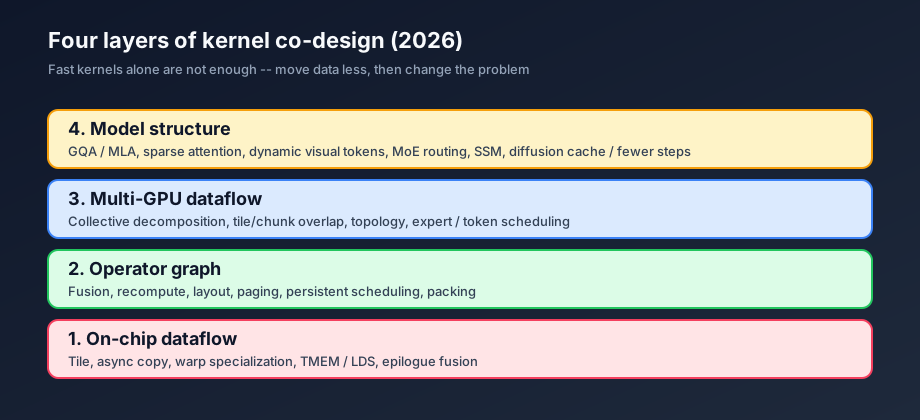
Four layers of foundation-model kernel co-design: on-chip dataflow, operator graph, multi-GPU dataflow, model structure

Foundation Model Kernel Optimization in 2026: A Field Guide Across Dense, MoE, Multimodal, and Diffusion

Foundation Model Kernel Optimization in 2026: A Field Guide Across Dense, MoE, Multimodal, and Diffusion Most “kernel optimization” conversations still start with FLOPs. In 2026 that is usually the wrong first question. Foundation-model runtime is dominated by HBM traffic, KV cache, temporary tensors, collectives, dynamic permutation, and launch overhead. FlashAttention, fused linear–cross-entropy, paged KV, MoE grouped GEMM, and DeepEP-style dispatch all share one essence: do not materialize intermediates, or make each byte travel once. ...
July 16, 2026 · 36 min · Duo An
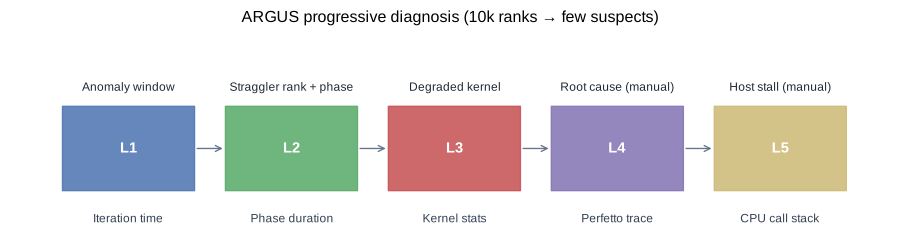
ARGUS progressive diagnosis levels from iteration time to kernel stats

Paper Reading: ARGUS — Always-On Tracing at 10,000+ GPU Scale

Paper Reading: ARGUS — Always-On Tracing at 10,000+ GPU Scale What Tencent built to catch fail-slow training jobs on 10k+ GPU clusters with under 2% overhead — plus Modal remasurements of CUPTI Activity API / torch.profiler / nsys overhead, case-study reproductions, and the KDE + W₁ detection path. Paper: ARGUS: Production-Scale Tracing and Performance Diagnosis for over 10,000-GPU Clusters (Zhou et al., Tencent, arXiv 2606.20374, submitted to ATC 2026) TL;DR Large LLM training jobs are synchronous: one slow rank, link, or host-side stall can waste thousands of GPU-hours without triggering a hard failure. Existing tools split into two camps: ...

July 13, 2026 · 15 min · Duo An
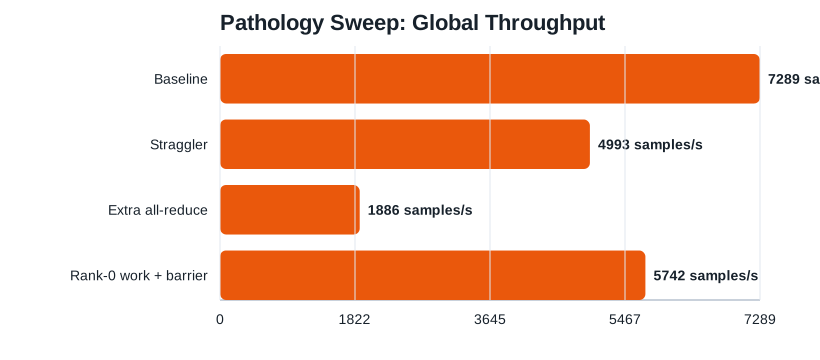
DDP throughput under straggler and communication pathologies

Learning PyTorch DDP Performance Tuning on a One-GPU Machine

Learning PyTorch DDP Performance Tuning on a One-GPU Machine How to build real intuition for DistributedDataParallel scaling, stragglers, communication, and synchronization even when you only have one GPU. TL;DR Most DDP performance problems are easier to understand than they first look. In this post I built a small single-machine lab that uses CPU gloo processes to reproduce the part of DDP reasoning that matters most: the slowest rank often sets the pace small per-rank work hurts scaling communication can dominate step time rank-0-only host work becomes everyone’s problem once you synchronize The important numbers from the lab were: ...

February 18, 2026 · 15 min · Duo An
Capacity planning pipeline from intent to parallelism

From Scaling Laws to Cluster Size: Capacity Planning That Survives Contact With GPUs

From Scaling Laws to Cluster Size: Capacity Planning That Survives Contact With GPUs Scaling laws tell you how loss should move with tokens and parameters. Clusters tell you what you can actually buy. Capacity planning is the bridge — and most teams skip it until the first failed launch burns a week of calendar time and a pile of GPU-hours. This post is a reproducible planning pipeline: tokens → steps → FLOPs → GPU-hours → forced parallelism. The arithmetic lives in playground/capacity_plan.py; the figures below are generated from its JSON output. Not exact. Accurate enough to catch 10× fantasy plans. ...

February 2, 2025 · 4 min · Duo An