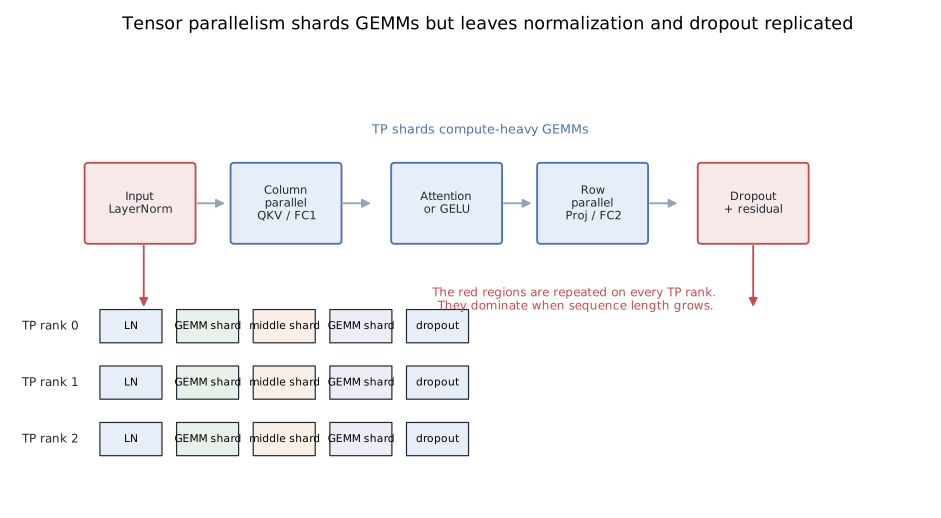
Tensor parallelism leaves LayerNorm and Dropout activations replicated while Megatron SP shards them along sequence

Sequence Parallelism I: Megatron SP Cuts Activation Memory Along the Sequence

Sequence Parallelism I: Megatron SP Cuts Activation Memory Along the Sequence Tensor parallelism is usually introduced as a way to make matrix multiplications fit. That is true, but it hides a second problem. After the weights are split, many activations are still replicated on every tensor-parallel rank. For short contexts this is tolerable. For long contexts it becomes one of the reasons training throughput collapses into activation checkpointing. Megatron sequence parallelism, usually shortened to Megatron SP, is a targeted fix from Reducing Activation Recomputation in Large Transformer Models (arXiv:2205.05198). It does not replace tensor parallelism. It keeps Megatron’s column-parallel and row-parallel linear layers, then shards the sequence-local regions that tensor parallelism had left replicated. The trick is small enough to miss and important enough to change the memory budget of a whole Transformer block. ...
May 12, 2025 · 8 min · Duo An
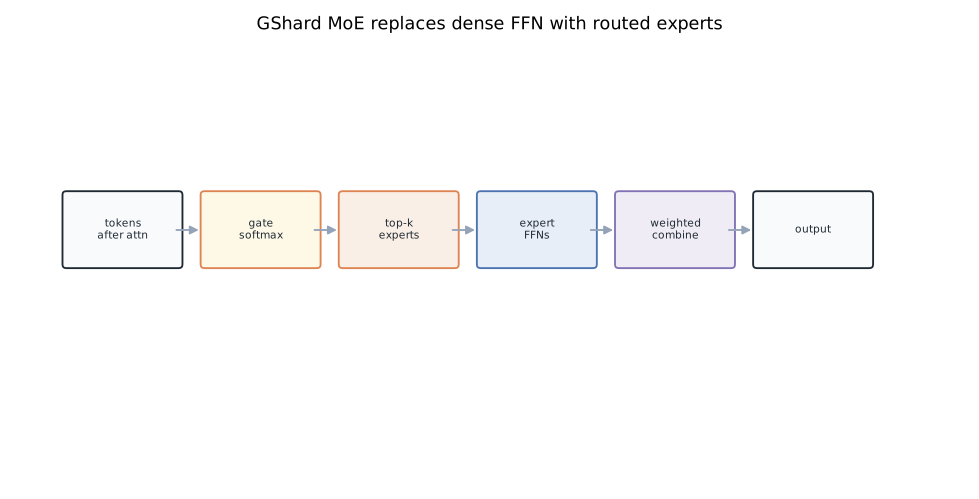
GShard-style MoE layer with gate, experts, and top-k combine

MoE Parallelism Principles: GShard, Expert Parallel, and All-to-All

MoE Parallelism Principles: GShard, Expert Parallel, and All-to-All Mixture-of-Experts is sparse compute wrapped in a communication problem. The model idea is simple: replace a dense FFN with many expert FFNs and route each token to a few of them. The distributed-training problem starts when those experts live on different GPUs. Shazeer et al. introduced the sparsely-gated MoE layer in Outrageously Large Neural Networks. GShard made the pattern practical at scale with top-2 routing, capacity, load-balancing loss, and all-to-all dispatch in GShard. Switch simplified the router to top-1 in Switch Transformers. This post explains the shared systems model underneath them. ...

May 10, 2025 · 8 min · Duo An
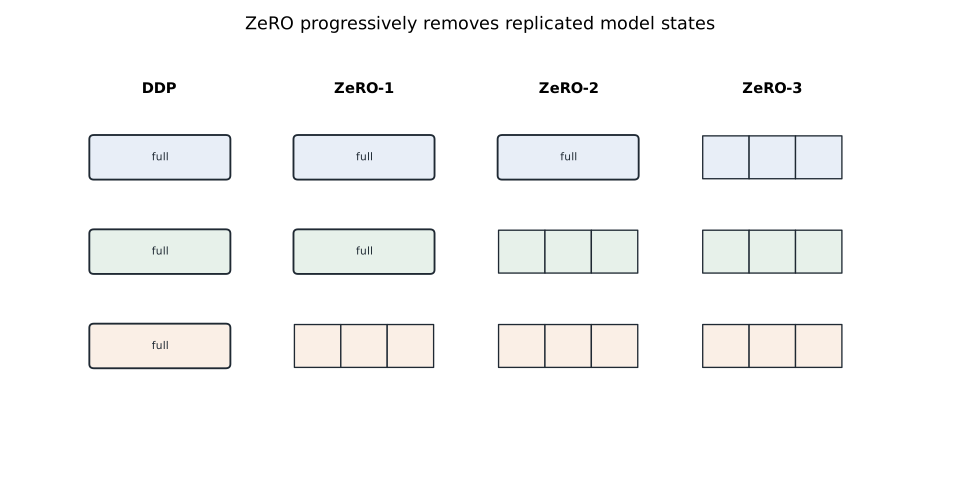
ZeRO stages partition optimizer state, gradients, and parameters

ZeRO: Partitioning Optimizer State, Gradients, and Parameters

ZeRO: Partitioning Optimizer State, Gradients, and Parameters Plain DDP is clean but wasteful. Every data-parallel rank stores the same parameters, gradients, fp32 master weights, and optimizer moments. At small scale that redundancy is convenient. At LLM scale it is the memory wall. ZeRO, the Zero Redundancy Optimizer, keeps data-parallel semantics and removes the redundant storage one category at a time. ZeRO-1 shards optimizer state. ZeRO-2 shards optimizer state and gradients. ZeRO-3 shards optimizer state, gradients, and parameters (arXiv:1910.02054). ...

April 27, 2025 · 9 min · Duo An
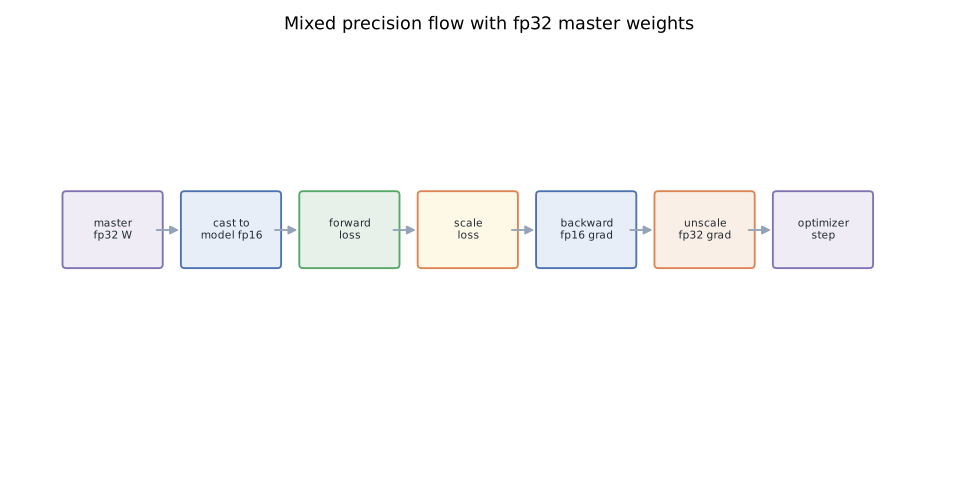
Mixed precision training flow with fp32 master weights and loss scaling

Megatron Internals III: Mixed Precision, Loss Scaling, and Grad Clipping

Megatron Internals III: Mixed Precision, Loss Scaling, and Grad Clipping Mixed precision training is not just “turn on fp16.” It is a state machine: fast low-precision tensors do forward and backward, stable fp32 tensors receive optimizer updates, and every rank agrees whether the step is valid before any shard changes. The classic recipe comes from Micikevicius et al., Mixed Precision Training: use lower precision where hardware is fast, keep fp32 master weights for updates, and use loss scaling when fp16 gradients underflow. Megatron wraps that recipe around tensor, pipeline, and data parallelism. ...

April 26, 2025 · 8 min · Duo An
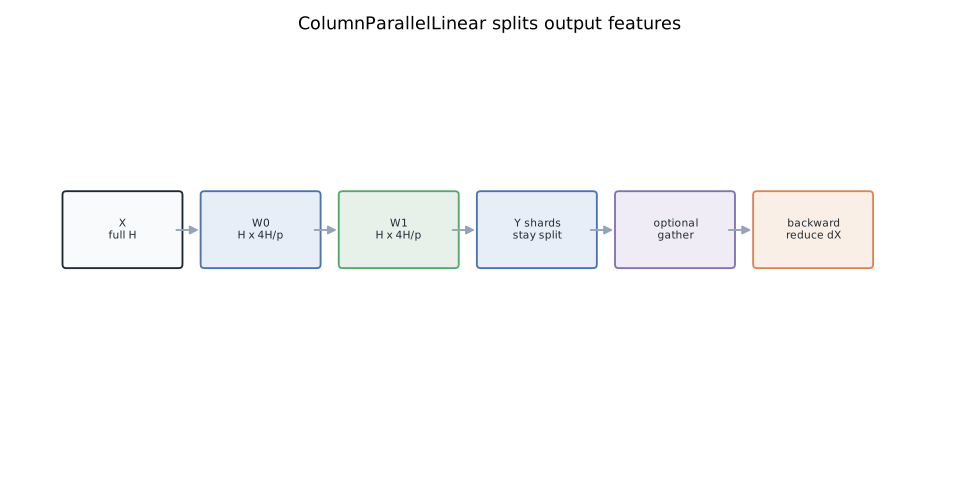
Column-parallel linear layer splitting output features across tensor-parallel ranks

Megatron Internals II: Column/Row Parallel Linear and Vocab Parallel Embedding

Megatron Internals II: Column/Row Parallel Linear and Vocab Parallel Embedding Tensor parallelism is not “split every tensor somehow.” In Megatron, it is a small set of layer contracts: which dimension is local, which collective completes the dense math, and which gradient path communicates. The original Megatron-LM paper is still the cleanest starting point: split transformer matrix multiplies so each GPU does useful dense GEMM, then communicate only where the algebra requires it. This post walks the implementation-level contracts behind ColumnParallelLinear, RowParallelLinear, VocabParallelEmbedding, and parallel cross entropy. ...

April 19, 2025 · 7 min · Duo An