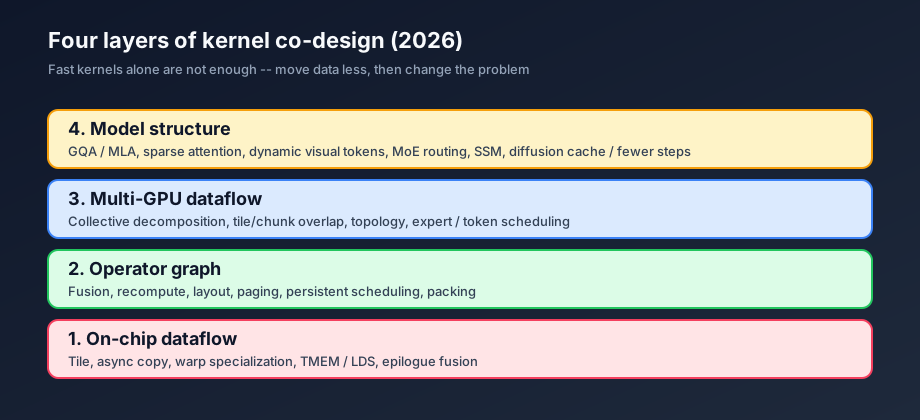
Four layers of foundation-model kernel co-design: on-chip dataflow, operator graph, multi-GPU dataflow, model structure

Foundation Model Kernel Optimization in 2026: A Field Guide Across Dense, MoE, Multimodal, and Diffusion

Foundation Model Kernel Optimization in 2026: A Field Guide Across Dense, MoE, Multimodal, and Diffusion Most “kernel optimization” conversations still start with FLOPs. In 2026 that is usually the wrong first question. Foundation-model runtime is dominated by HBM traffic, KV cache, temporary tensors, collectives, dynamic permutation, and launch overhead. FlashAttention, fused linear–cross-entropy, paged KV, MoE grouped GEMM, and DeepEP-style dispatch all share one essence: do not materialize intermediates, or make each byte travel once. ...
July 16, 2026 · 36 min · Duo An
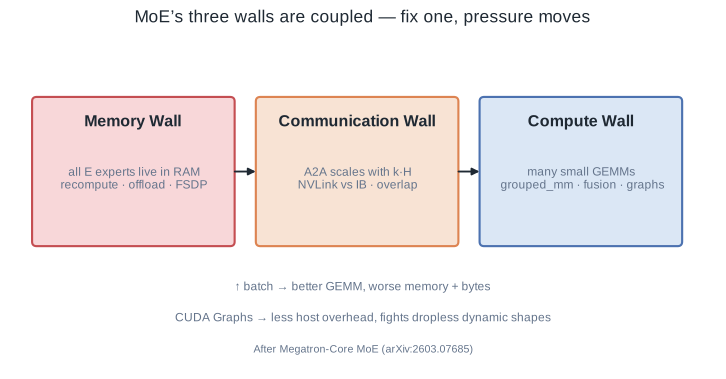
MoE training’s three coupled walls: memory, communication, compute

Large MoE Performance: The Three Walls After Sparsity

Large MoE Performance: The Three Walls After Sparsity Sparsity made MoE cheap on paper. At production scale it made training harder than dense: total parameters grow with E, per-token FLOPs grow with k, and the gap between those two numbers is exactly where systems break. The useful framing is not “optimize the MoE kernel.” It is the one NVIDIA’s Megatron-Core MoE report uses (arXiv:2603.07685): Memory, Communication, and Compute Efficiency are three coupled walls. Push on one and pressure shows up in another. ByteDance’s MegaScale-MoE (arXiv:2505.11432) proves the same thesis from the other direction — on 1,440 Hoppers, communication was ~44% of forward time before their redesign, and fixing parallelism + overlap delivered 1.88× over Megatron-LM. ...

July 4, 2026 · 12 min · Duo An
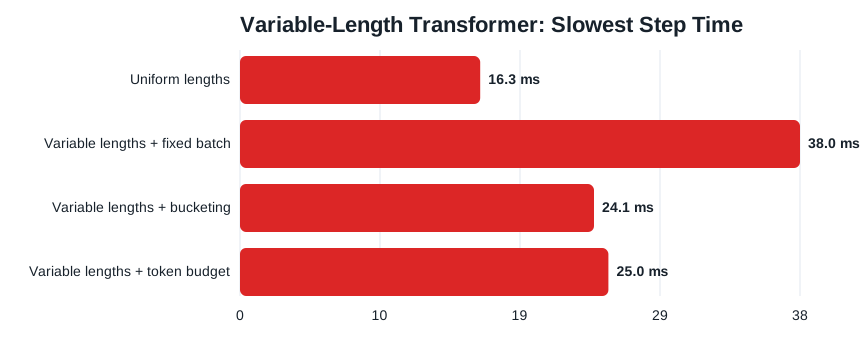
Step time under different variable-length batching strategies

Why Variable Sequence Length Breaks DDP Throughput

Why Variable Sequence Length Breaks DDP Throughput How to reproduce, measure, and fix token skew in transformer training with length bucketing and token-budget batching. TL;DR In transformer training, DDP can look balanced by sample count while being badly imbalanced by actual work. I built a small one-machine lab that uses a tiny transformer-like model with variable sequence lengths and four distributed ranks. The headline result was simple: uniform 128-token batches: 250,959 tokens/s variable lengths with fixed sample count: 122,006 tokens/s variable lengths with length bucketing: 208,668 tokens/s variable lengths with token-budget batching: 193,289 tokens/s The bad case was not a kernel problem. It was a batching problem: ...

March 12, 2026 · 8 min · Duo An
Capacity planning pipeline from intent to parallelism

From Scaling Laws to Cluster Size: Capacity Planning That Survives Contact With GPUs

From Scaling Laws to Cluster Size: Capacity Planning That Survives Contact With GPUs Scaling laws tell you how loss should move with tokens and parameters. Clusters tell you what you can actually buy. Capacity planning is the bridge — and most teams skip it until the first failed launch burns a week of calendar time and a pile of GPU-hours. This post is a reproducible planning pipeline: tokens → steps → FLOPs → GPU-hours → forced parallelism. The arithmetic lives in playground/capacity_plan.py; the figures below are generated from its JSON output. Not exact. Accurate enough to catch 10× fantasy plans. ...

February 2, 2025 · 4 min · Duo An