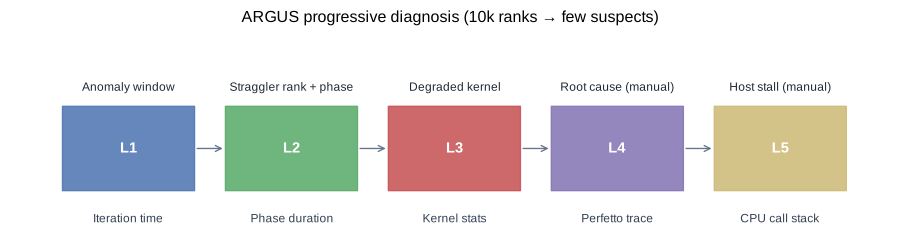
ARGUS progressive diagnosis levels from iteration time to kernel stats

Paper Reading: ARGUS — Always-On Tracing at 10,000+ GPU Scale

Paper Reading: ARGUS — Always-On Tracing at 10,000+ GPU Scale What Tencent built to catch fail-slow training jobs on 10k+ GPU clusters with under 2% overhead — plus Modal remasurements of CUPTI Activity API / torch.profiler / nsys overhead, case-study reproductions, and the KDE + W₁ detection path. Paper: ARGUS: Production-Scale Tracing and Performance Diagnosis for over 10,000-GPU Clusters (Zhou et al., Tencent, arXiv 2606.20374, submitted to ATC 2026) TL;DR Large LLM training jobs are synchronous: one slow rank, link, or host-side stall can waste thousands of GPU-hours without triggering a hard failure. Existing tools split into two camps: ...
July 13, 2026 · 15 min · Duo An
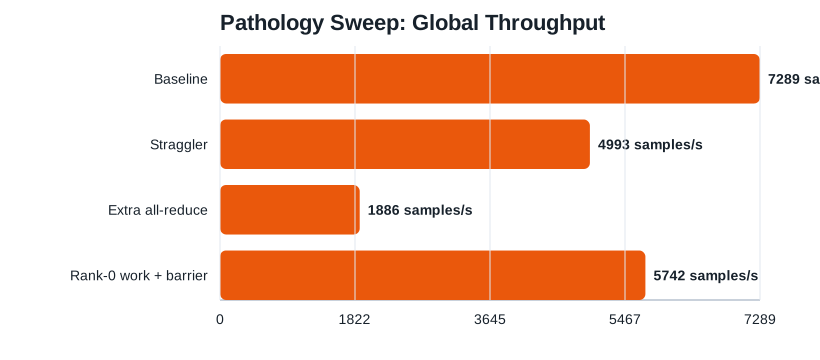
DDP throughput under straggler and communication pathologies

Learning PyTorch DDP Performance Tuning on a One-GPU Machine

Learning PyTorch DDP Performance Tuning on a One-GPU Machine How to build real intuition for DistributedDataParallel scaling, stragglers, communication, and synchronization even when you only have one GPU. TL;DR Most DDP performance problems are easier to understand than they first look. In this post I built a small single-machine lab that uses CPU gloo processes to reproduce the part of DDP reasoning that matters most: the slowest rank often sets the pace small per-rank work hurts scaling communication can dominate step time rank-0-only host work becomes everyone’s problem once you synchronize The important numbers from the lab were: ...

February 18, 2026 · 15 min · Duo An
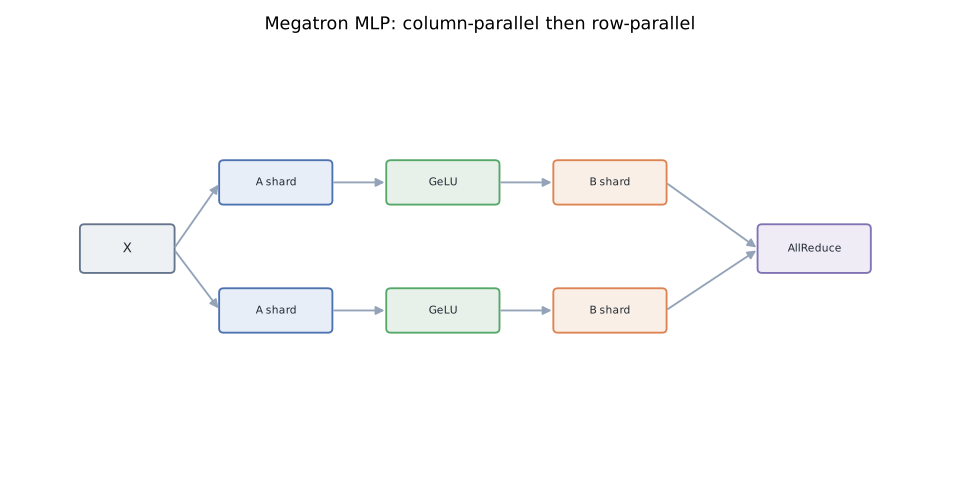
Megatron-LM tensor parallel MLP with column and row splits

Tensor Parallelism in Megatron-LM: Splitting Layers, Not Stacks

Tensor Parallelism in Megatron-LM: Splitting Layers, Not Stacks Pipeline parallelism splits a model by depth. Tensor parallelism splits the math inside one layer. Megatron-LM made tensor parallelism practical for Transformers by choosing split points that preserve local GEMMs and put collectives only where the algebra requires them. The original Megatron paper introduced the core intra-layer pattern (arXiv:1909.08053). The later Megatron-LM systems paper showed how that TP axis composes with data and pipeline parallelism at cluster scale (arXiv:2104.04473). ...

May 18, 2025 · 8 min · Duo An
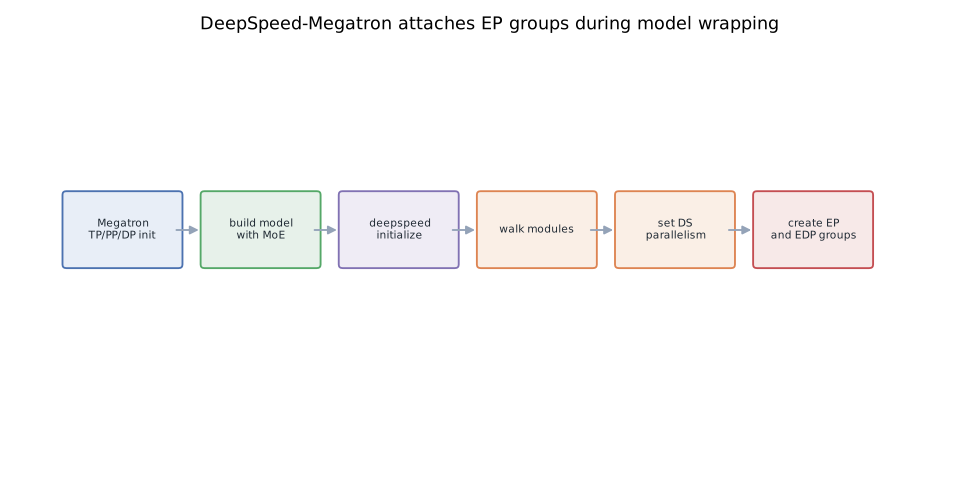
DeepSpeed-Megatron MoE initialization flow creating expert-parallel groups during model wrapping

MoE Internals: DeepSpeed-Megatron Expert Parallel Implementation

MoE Internals: DeepSpeed-Megatron Expert Parallel Implementation DeepSpeed-Megatron MoE is easy to misread if you only inspect one initialization function. Megatron builds the usual TP, PP, and DP topology. DeepSpeed then wraps the model, finds MoE modules, and gives those modules expert-parallel groups. The topology is split across the training framework and the MoE layer implementation. This post connects the pieces: deepspeed.initialize(), EP groups, expert-DP groups, MoELayer, and the difference between a DeepSpeed MoE wrapper and a Megatron-integrated SwitchMLP-style module. For routing, capacity, and All-to-All fundamentals, start with MoE Parallelism Principles. ...

May 17, 2025 · 8 min · Duo An
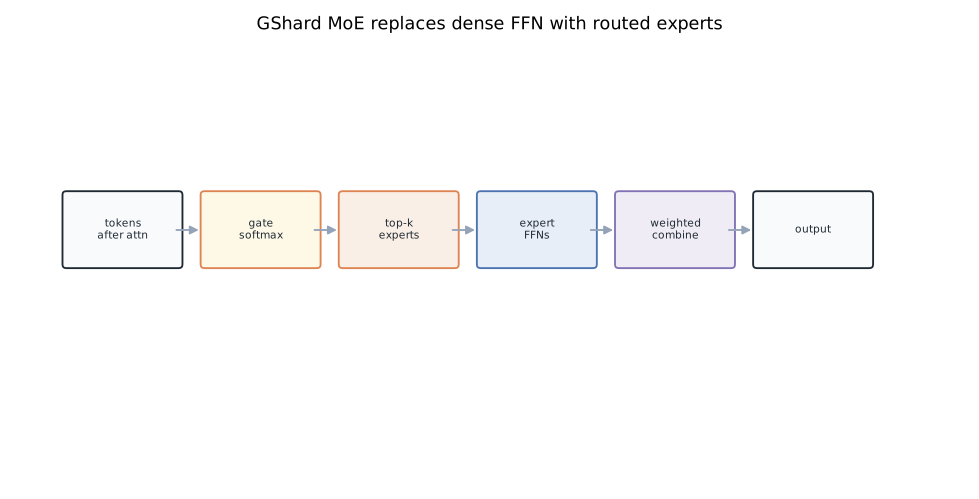
GShard-style MoE layer with gate, experts, and top-k combine

MoE Parallelism Principles: GShard, Expert Parallel, and All-to-All

MoE Parallelism Principles: GShard, Expert Parallel, and All-to-All Mixture-of-Experts is sparse compute wrapped in a communication problem. The model idea is simple: replace a dense FFN with many expert FFNs and route each token to a few of them. The distributed-training problem starts when those experts live on different GPUs. Shazeer et al. introduced the sparsely-gated MoE layer in Outrageously Large Neural Networks. GShard made the pattern practical at scale with top-2 routing, capacity, load-balancing loss, and all-to-all dispatch in GShard. Switch simplified the router to top-1 in Switch Transformers. This post explains the shared systems model underneath them. ...

May 10, 2025 · 8 min · Duo An