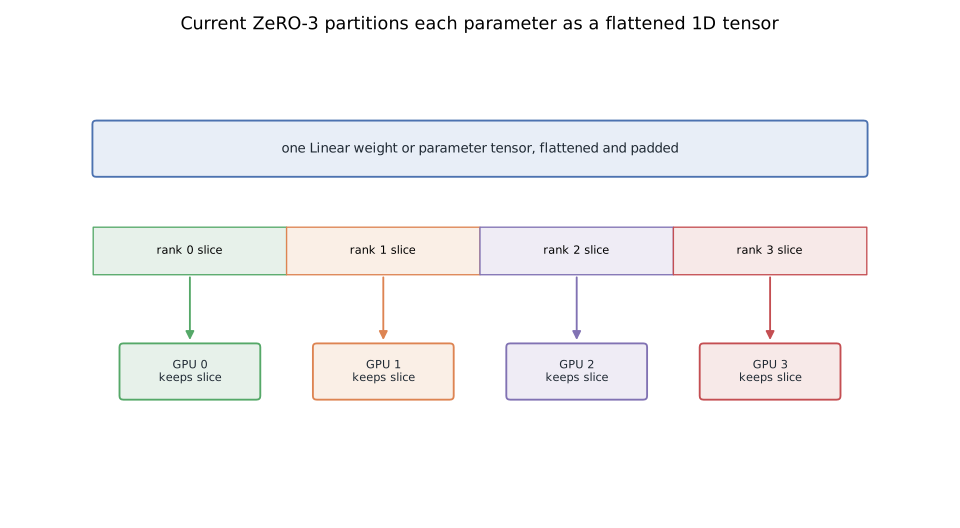
Current DeepSpeed ZeRO-3 partitions each parameter as flattened intra-layer slices across ranks

The ZeRO-3 Diagram Most People Remember Is Wrong

The ZeRO-3 Diagram Most People Remember Is Wrong Many engineers first learned ZeRO-3 from an animation that looked like pipeline parallelism. One GPU owned early layers, another GPU owned later layers, and the active layer block appeared to be broadcast to all other GPUs when needed. That picture is memorable. It is also not the right mental model for current DeepSpeed ZeRO-3 training. The current steady-state model is intra-layer partitioning. Each parameter is flattened, padded if necessary, and split across data-parallel ranks. Before forward or backward compute needs that parameter, ranks AllGather the full parameter. After gradients are produced, ranks ReduceScatter gradients back to the owning shards. That is the operational reading of ZeRO-3 from the ZeRO paper (arXiv:1910.02054) and the current DeepSpeed runtime. ...
June 16, 2025 · 8 min · Duo An
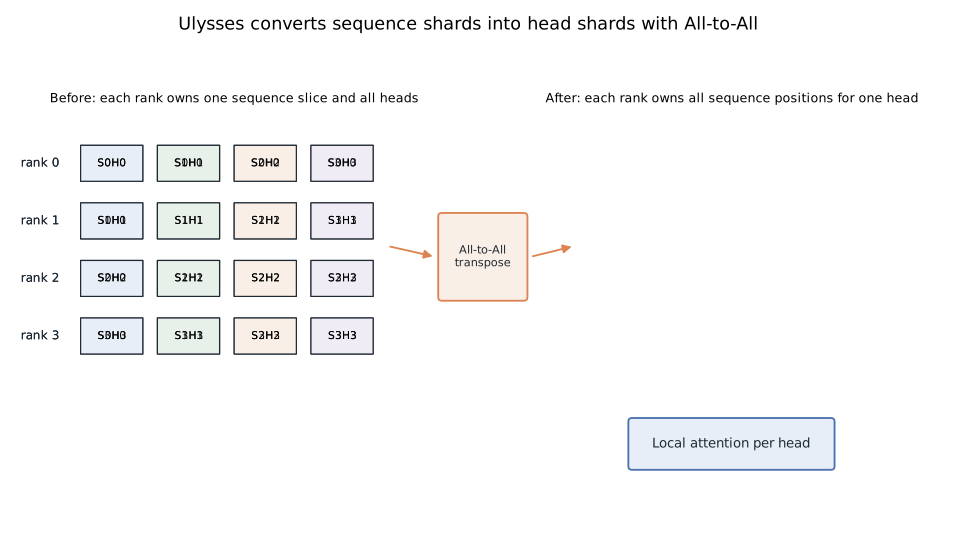
Ulysses sequence-shards activations and uses All-to-All to make each rank own all tokens for one attention head

Sequence Parallelism II: DeepSpeed Ulysses and All-to-All Attention

Sequence Parallelism II: DeepSpeed Ulysses and All-to-All Attention Megatron SP is a careful memory optimization around an existing tensor-parallel block. DeepSpeed Ulysses starts from a different question. What if each device owns a sequence slice most of the time, but attention temporarily wants each device to own a head slice instead? The answer in DeepSpeed Ulysses is an All-to-All transpose (arXiv:2309.14509). Before attention, every rank has all heads for a subset of tokens. After All-to-All, every rank has all tokens for a subset of heads. That one layout change lets local attention run per head while the rest of the layer can remain sequence-sharded. ...

May 19, 2025 · 8 min · Duo An
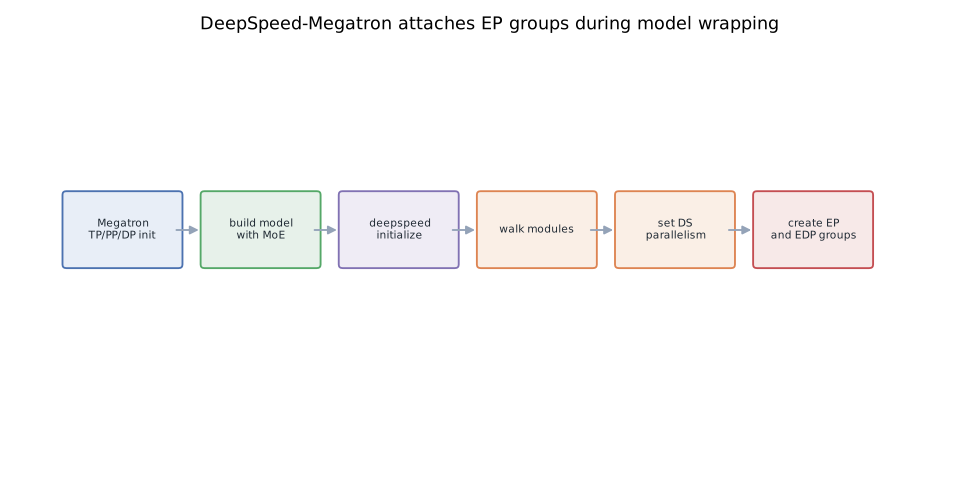
DeepSpeed-Megatron MoE initialization flow creating expert-parallel groups during model wrapping

MoE Internals: DeepSpeed-Megatron Expert Parallel Implementation

MoE Internals: DeepSpeed-Megatron Expert Parallel Implementation DeepSpeed-Megatron MoE is easy to misread if you only inspect one initialization function. Megatron builds the usual TP, PP, and DP topology. DeepSpeed then wraps the model, finds MoE modules, and gives those modules expert-parallel groups. The topology is split across the training framework and the MoE layer implementation. This post connects the pieces: deepspeed.initialize(), EP groups, expert-DP groups, MoELayer, and the difference between a DeepSpeed MoE wrapper and a Megatron-integrated SwitchMLP-style module. For routing, capacity, and All-to-All fundamentals, start with MoE Parallelism Principles. ...

May 17, 2025 · 8 min · Duo An
ZeRO stages partition optimizer state, gradients, and parameters

ZeRO: Partitioning Optimizer State, Gradients, and Parameters

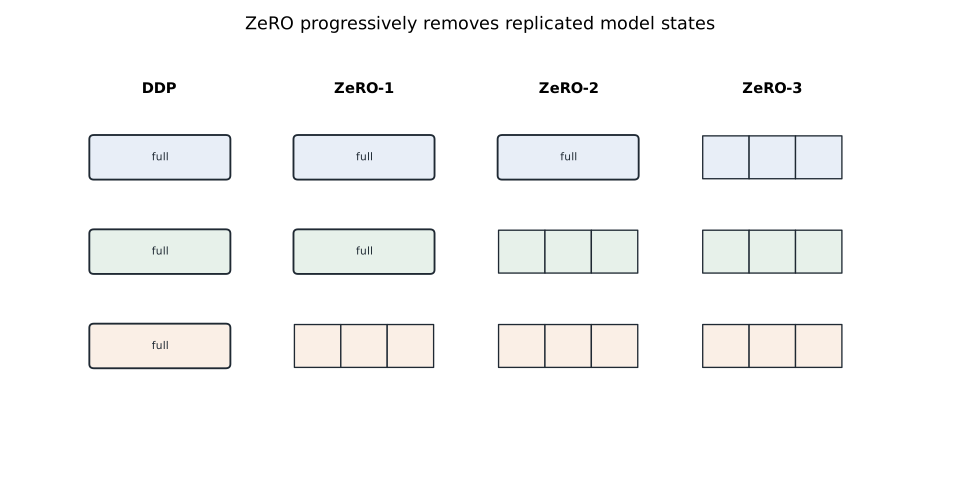
ZeRO: Partitioning Optimizer State, Gradients, and Parameters Plain DDP is clean but wasteful. Every data-parallel rank stores the same parameters, gradients, fp32 master weights, and optimizer moments. At small scale that redundancy is convenient. At LLM scale it is the memory wall. ZeRO, the Zero Redundancy Optimizer, keeps data-parallel semantics and removes the redundant storage one category at a time. ZeRO-1 shards optimizer state. ZeRO-2 shards optimizer state and gradients. ZeRO-3 shards optimizer state, gradients, and parameters (arXiv:1910.02054). ...

April 27, 2025 · 9 min · Duo An
Map of distributed LLM training techniques across DP, TP, PP, SP, ZeRO, and MoE

LLM Training Series: A Systems Map for Distributed Transformers

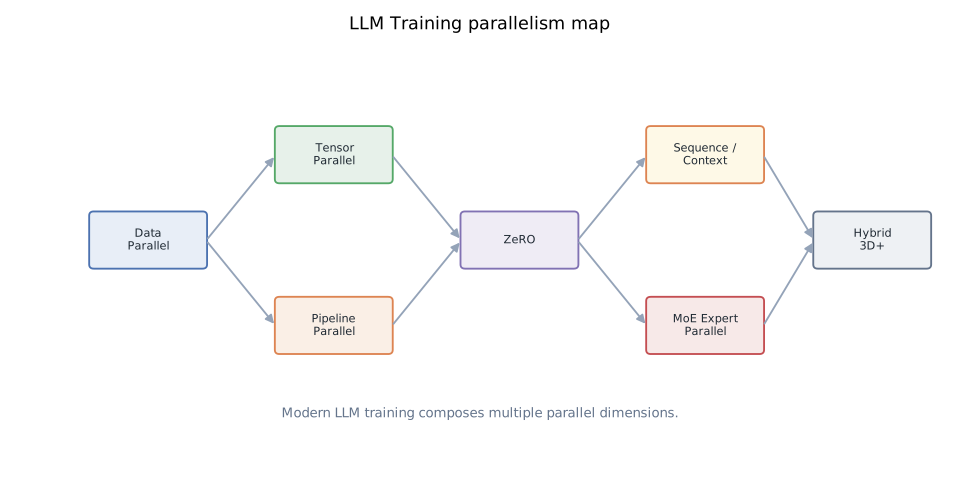
LLM Training Series: A Systems Map for Distributed Transformers LLM training stops being “run the model on more GPUs” the moment one replica no longer fits, one link becomes the step time, or one schedule leaves half the cluster idle. From that point on, the training run is a placement problem. The stable question is simple: which bytes are replicated, which bytes are sharded, and which link moves them on the critical path? Data parallelism, tensor parallelism, pipeline parallelism, ZeRO, sequence/context parallelism, and expert parallelism are different answers to that question. The public systems that matter - GPipe, Megatron-LM, DeepSpeed ZeRO, PyTorch DDP, GShard, Switch Transformer, and modern Megatron-Core - all expose the same constraints in different shapes (GPipe, Megatron-LM, ZeRO, PyTorch Distributed, GShard, Switch Transformer). ...

March 2, 2025 · 8 min · Duo An