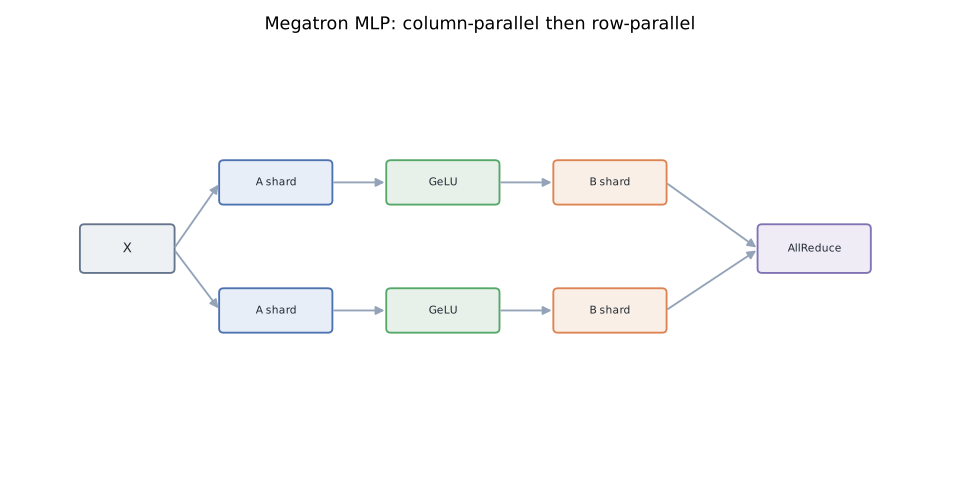
Megatron-LM tensor parallel MLP with column and row splits

Tensor Parallelism in Megatron-LM: Splitting Layers, Not Stacks

Tensor Parallelism in Megatron-LM: Splitting Layers, Not Stacks Pipeline parallelism splits a model by depth. Tensor parallelism splits the math inside one layer. Megatron-LM made tensor parallelism practical for Transformers by choosing split points that preserve local GEMMs and put collectives only where the algebra requires them. The original Megatron paper introduced the core intra-layer pattern (arXiv:1909.08053). The later Megatron-LM systems paper showed how that TP axis composes with data and pipeline parallelism at cluster scale (arXiv:2104.04473). ...
May 18, 2025 · 8 min · Duo An
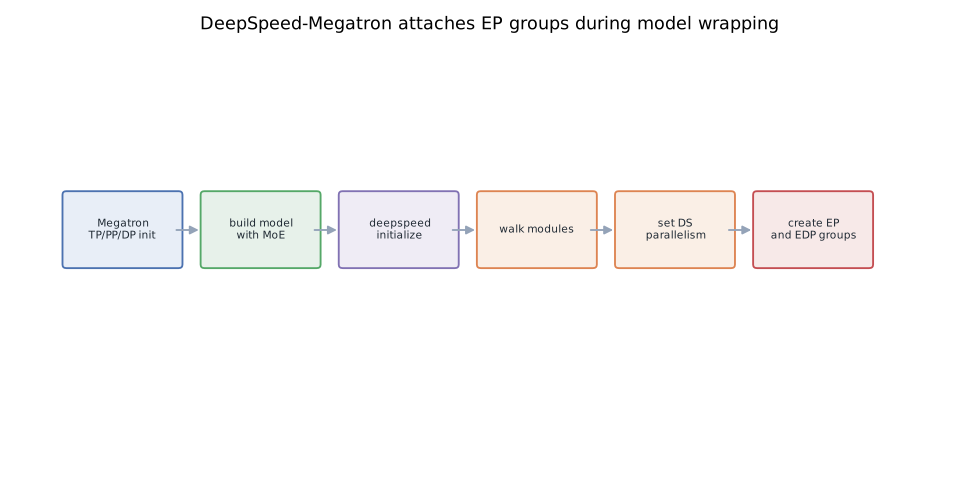
DeepSpeed-Megatron MoE initialization flow creating expert-parallel groups during model wrapping

MoE Internals: DeepSpeed-Megatron Expert Parallel Implementation

MoE Internals: DeepSpeed-Megatron Expert Parallel Implementation DeepSpeed-Megatron MoE is easy to misread if you only inspect one initialization function. Megatron builds the usual TP, PP, and DP topology. DeepSpeed then wraps the model, finds MoE modules, and gives those modules expert-parallel groups. The topology is split across the training framework and the MoE layer implementation. This post connects the pieces: deepspeed.initialize(), EP groups, expert-DP groups, MoELayer, and the difference between a DeepSpeed MoE wrapper and a Megatron-integrated SwitchMLP-style module. For routing, capacity, and All-to-All fundamentals, start with MoE Parallelism Principles. ...

May 17, 2025 · 8 min · Duo An
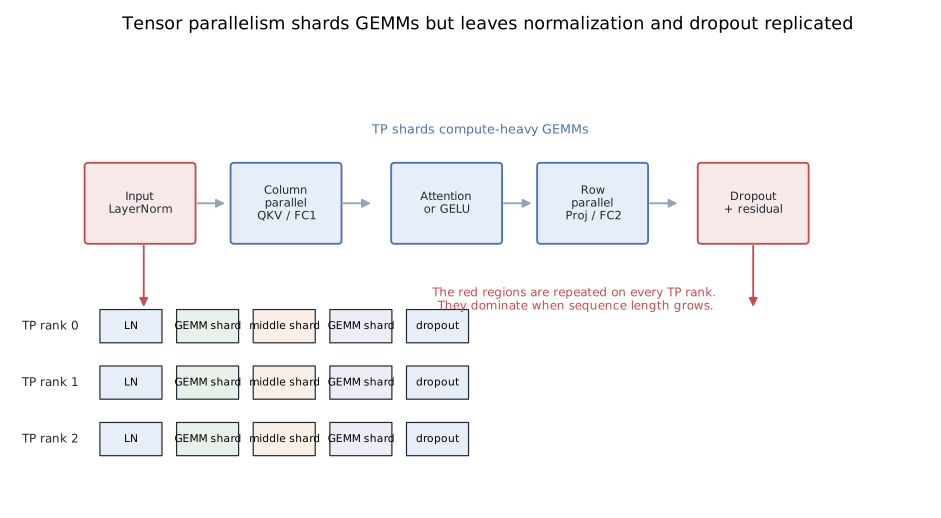
Tensor parallelism leaves LayerNorm and Dropout activations replicated while Megatron SP shards them along sequence

Sequence Parallelism I: Megatron SP Cuts Activation Memory Along the Sequence

Sequence Parallelism I: Megatron SP Cuts Activation Memory Along the Sequence Tensor parallelism is usually introduced as a way to make matrix multiplications fit. That is true, but it hides a second problem. After the weights are split, many activations are still replicated on every tensor-parallel rank. For short contexts this is tolerable. For long contexts it becomes one of the reasons training throughput collapses into activation checkpointing. Megatron sequence parallelism, usually shortened to Megatron SP, is a targeted fix from Reducing Activation Recomputation in Large Transformer Models (arXiv:2205.05198). It does not replace tensor parallelism. It keeps Megatron’s column-parallel and row-parallel linear layers, then shards the sequence-local regions that tensor parallelism had left replicated. The trick is small enough to miss and important enough to change the memory budget of a whole Transformer block. ...

May 12, 2025 · 8 min · Duo An
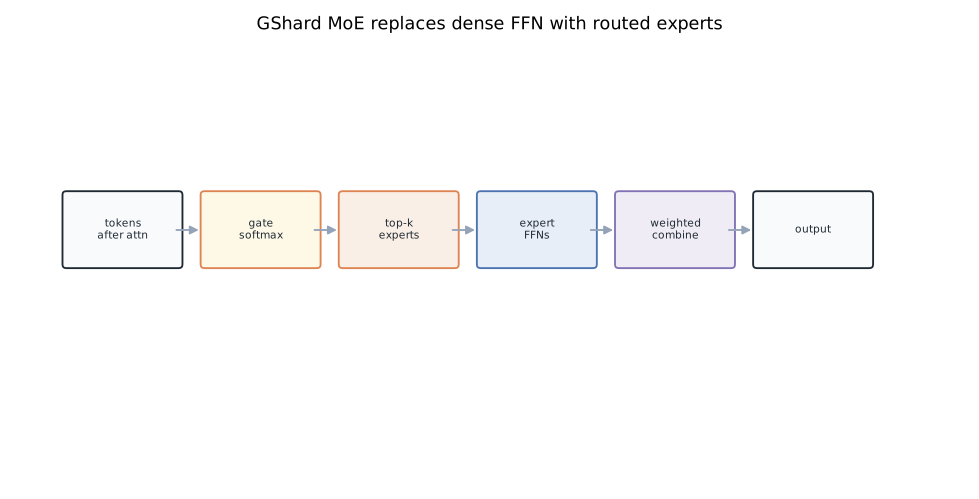
GShard-style MoE layer with gate, experts, and top-k combine

MoE Parallelism Principles: GShard, Expert Parallel, and All-to-All

MoE Parallelism Principles: GShard, Expert Parallel, and All-to-All Mixture-of-Experts is sparse compute wrapped in a communication problem. The model idea is simple: replace a dense FFN with many expert FFNs and route each token to a few of them. The distributed-training problem starts when those experts live on different GPUs. Shazeer et al. introduced the sparsely-gated MoE layer in Outrageously Large Neural Networks. GShard made the pattern practical at scale with top-2 routing, capacity, load-balancing loss, and all-to-all dispatch in GShard. Switch simplified the router to top-1 in Switch Transformers. This post explains the shared systems model underneath them. ...

May 10, 2025 · 8 min · Duo An
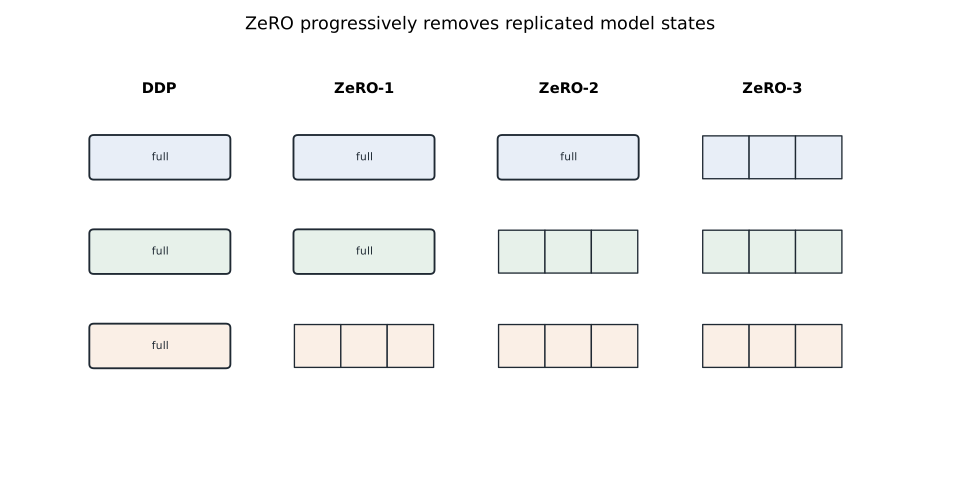
ZeRO stages partition optimizer state, gradients, and parameters

ZeRO: Partitioning Optimizer State, Gradients, and Parameters

ZeRO: Partitioning Optimizer State, Gradients, and Parameters Plain DDP is clean but wasteful. Every data-parallel rank stores the same parameters, gradients, fp32 master weights, and optimizer moments. At small scale that redundancy is convenient. At LLM scale it is the memory wall. ZeRO, the Zero Redundancy Optimizer, keeps data-parallel semantics and removes the redundant storage one category at a time. ZeRO-1 shards optimizer state. ZeRO-2 shards optimizer state and gradients. ZeRO-3 shards optimizer state, gradients, and parameters (arXiv:1910.02054). ...

April 27, 2025 · 9 min · Duo An