SiQ-VL: A Curriculum for Small VLMs When Compute Is the Hard Constraint
Most VLM writeups assume a cluster. SiQ-VL started from the opposite constraint: one (or few) GPUs, and the question was which design choices still buy capability when you cannot buy FLOPs.
This post is the consolidated field guide for that project — architecture, token economics, staged training, and offline Chain-of-Thought (CoT) distillation — replacing three earlier notes that said the same thing three ways. Kernel-level throughput (how we pushed Stage-1 from ~15K to ~100K real tokens/s on Blackwell) lives in the companion post: Optimizing VLM Training on One GPU.
Repo: duoan/SiQ_VL · Tech report PDF · W&B
TL;DR
- Architecture: frozen SigLIP-2 + linear projector with pixel shuffle + Qwen2.5 (0.5B / 1.5B). No perceiver, no giant MLP connector.
- First systems knob: cut vision tokens before the LLM. On SigLIP-2 @ 512px, factor-4 shuffle takes 1024 → 64 patches and drops estimated training memory ~23% (10.8 → 8.3 GB in our analytical breakdown).
- Curriculum, not end-to-end: Stage 1 = projector only · Stage 2 = instruction/VQA (LLM LoRA or full) · Stage 3 = offline multi-teacher CoT. Merge them and you cannot tell alignment failure from reasoning failure.
- Reasoning is data, not magic. Generate
(image, question, rationale, answer)offline from complementary teachers; never park a teacher on the training GPU. - Throughput is a different article. Once the curriculum is honest, go optimize kernels: five-layer recipe with measured tok/s.
The Constraint Reframe
Under abundant compute, the default stack is: scale data, unfreeze everything, maybe RL. Under a hard GPU budget, each of those choices multiplies failure modes.
The useful reframe:
Which single capability am I buying with this stage’s FLOPs?
SiQ-VL’s answer is a narrow trainable surface early, a short vision sequence always, and reasoning injected as supervised traces — not hoped for as emergence.
Architecture: Connect the Dots Deliberately
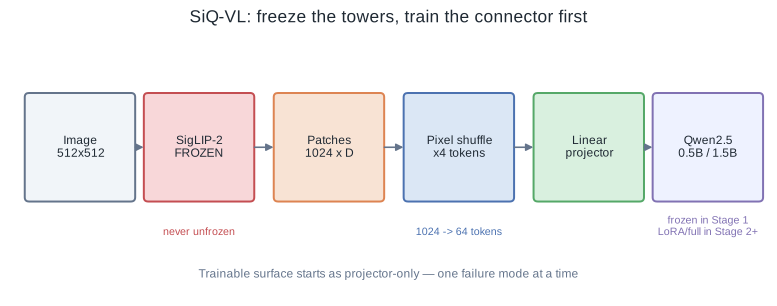
| Component | Role | Trainable? |
|---|---|---|
| SigLIP-2 vision tower | Image → patch features | Never (all stages) |
| Pixel-shuffle + linear projector | Compress + map into LLM space | Always |
| Qwen2.5 0.5B / 1.5B | Language / answers | Frozen in Stage 1; LoRA or full from Stage 2 |
No exotic connector. The projector is the only moving part in Stage 1, which is exactly why Stage 1 is debuggable: if outputs are gibberish, you have an alignment problem, not a “model too small” story.
Checkpoints (1.5B path): Stage 1 · Stage 2
Vision Tokens Are the First Memory Wall
Vision encoders are expensive less because of parameter count and more because of sequence length. Attention memory is in the LLM once patches are concatenated with text.
For siglip2-so400m-patch16-512:
| |
Feed all 1024 into Qwen next to a 2K text budget and you have already bought a long multimodal sequence. Pixel shuffle merges spatial groups before the linear map:
Shape sketch (factor 2, 384-class SigLIP path from the README): [B, 729, D] → [B, 182, 4D] → [B, 182, H_llm]. Same idea at 512px with a larger patch grid.
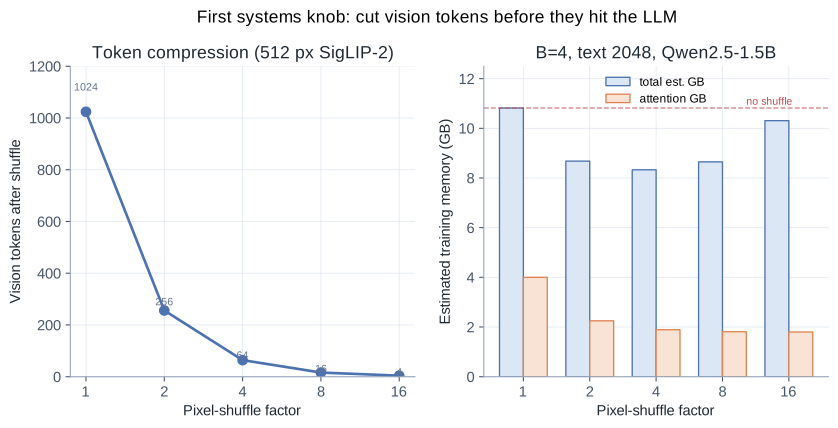
Numbers above are from the project’s analytical breakdown (MEMORY_ANALYSIS.md): B=4, text length 2048, Qwen2.5-1.5B, bf16. Factor 4 is the practical default (~8.3 GB est., 64 patches). Factor 32 is “valid” and disastrous — one patch of vision. Always set the factor explicitly.
Curriculum: One Capability Per Stage
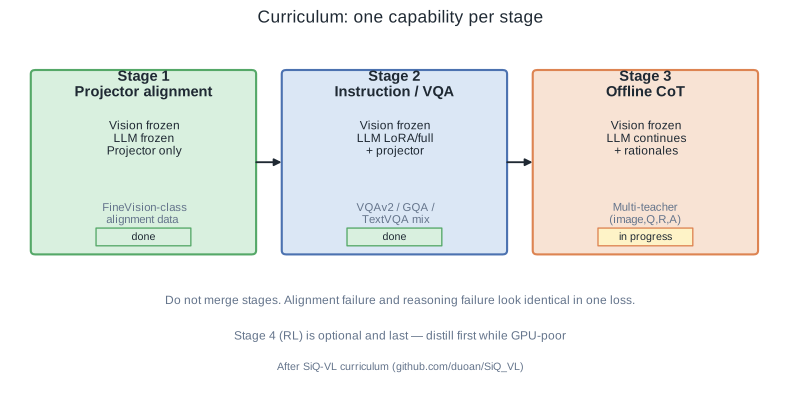
Stage 1 — Projector alignment
- Frozen: vision + LLM
- Trainable: projector
- Data: multimodal instruction / caption-style alignment (FineVision-class)
- Expected: fast convergence, often unusable answers. Alignment ≠ instruction following. That is a feature of the curriculum, not a bug.
Stage 2 — Instruction / VQA
- Frozen: vision
- Trainable: projector + LLM (LoRA on 4–5% of params was enough in our runs; full FT optional)
- Data: VQAv2 / GQA / TextVQA-style mixes
- Fixes: mixed-language junk, repetition, refusal-to-follow. Only after Stage 2 is the model a usable VLM.
Stage 3 — Offline CoT distillation
- Same freeze pattern as Stage 2
- Data: teacher-generated rationales, not online teacher–student
- Goal: structure and length of reasoning, not leaderboard theater
Stage 4 (RL) exists in the roadmap and stays last. Under GPU poverty, supervised CoT is the honest tool; RL is a tax you pay after the student already reasons.
Do not train alignment, instruction, and reasoning in one soup. The loss will go down either way. You will not know why.
Offline CoT: Pay Teachers Once
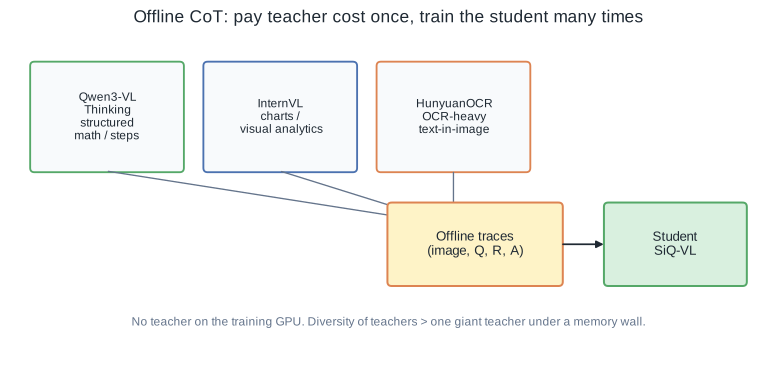
Online distillation keeps a large teacher on the critical path of every step. That is memory you do not have and a scheduling headache you do not need.
Offline distillation:
- Generate traces once from teachers with different biases
- Qwen3-VL-Thinking → structured multi-step
- InternVL → charts / visual analytics
- HunyuanOCR → text-heavy scenes
- Store
(image, question, rationale, answer) - Train the student many times without loading any teacher
What we actually saw (qualitative + light metrics, not a full leaderboard claim):
- Rationales got longer and more structured
- Hallucinations and brittle short answers dropped in inspection
- Running accuracy felt more stable
- ROUGE-L barely moved — surface n-gram overlap is a bad proxy for reasoning quality
Also: a text-only student distilled from multimodal teachers still picked up visual priors. A chunk of “visual commonsense” is linguistic structure. Distillation transfers that structure; it does not invent fine-grained perception the encoder never saw.
What offline CoT is not
- It does not fix teacher hallucinations
- It inherits teacher bias
- It does not replace representation learning
- It amplifies what Stage 1–2 already aligned
Minimal Recipe (Operational Checklist)
- Freeze harder than feels comfortable. Vision always; LLM until Stage 2 has a reason.
- Cut vision tokens before fusion. Factor 4 default on 512px SigLIP-2; measure memory, do not trust “auto max factor.”
- One stage, one job. Alignment → instruction → CoT.
- Inject reasoning as data. Offline multi-teacher traces beat hoping for emergence.
- Optimize for stable runs, then peak tok/s. Crashes waste more wall-clock than a 5% kernel miss.
- Only then chase kernels. BF16 truth, batching, fusion, packing — see the efficiency post.
How This Relates to the Throughput Work
Curriculum answers what to train when. The Blackwell sweep answers how fast each stage can run:
| Stage | 0.5B real tok/s | Speedup |
|---|---|---|
| Stage 1 | 14.7K → 100.9K | 6.86× |
| Stage 2 | 29.2K → 86.1K | 2.95× |
Same stack, different article. If you only read one systems follow-up, read that one.
Closing
SiQ-VL is not a claim that small VLMs beat frontier models. It is a claim about leverage under a memory wall: freeze, compress tokens, separate stages, distill reasoning offline. Architecture novelty is optional. Curriculum discipline is not.
When the curriculum is honest, the remaining work is engineering — and that is where measured tok/s belong.