Most “Scalable” Multimodal Pipelines Don’t Survive Foundation-Model Scale
A lot of multimodal pipelines claim to scale.
In practice, they often depend on at least one of the following:
- global shuffles (groupBy/join/repartition),
- materializing massive intermediate datasets,
- centralized coordination that becomes a bottleneck,
- or brittle recovery logic (rerun-the-world on failure).
That works for demos. It breaks at foundation-model scale.
This series is about a different design point:
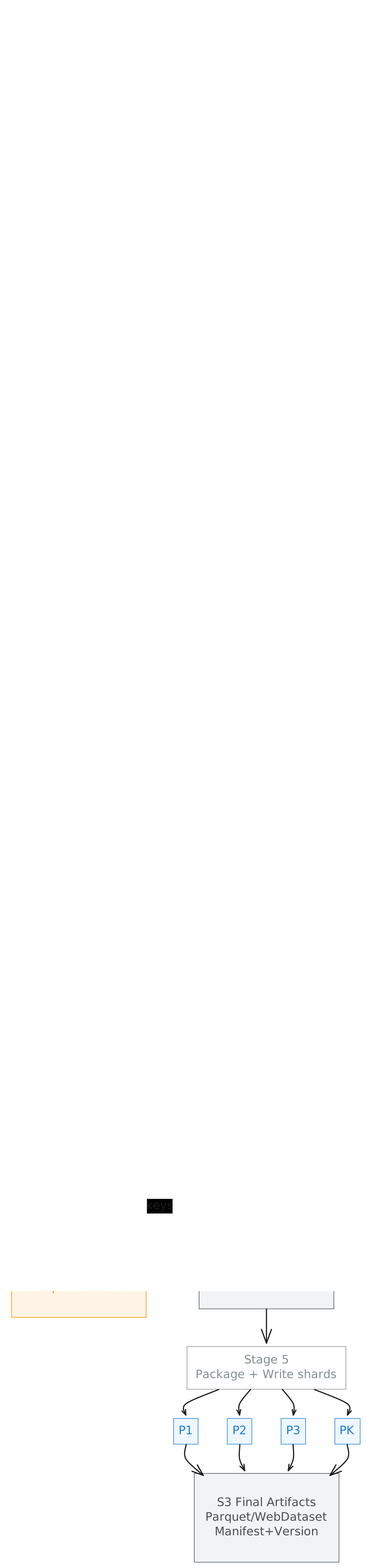
A streaming-first multimodal pipeline that scales linearly with data and hardware — with no global shuffle, and resumable at partition granularity.
This post lays out the philosophy.
Implementation details will follow in later posts.
Principle 1: Training Is Streaming — Data Must Be Streaming Too
Large VLM training is inherently streaming:
- read samples,
- tokenize/encode,
- run forward/backward,
- move on.
There is no “global regrouping” step in training.
Yet many data pipelines insist on:
- dataset-wide joins,
- global grouping,
- repeated reshuffles across the cluster.
That mismatch is the root cause of poor scalability.
If model training is streaming, the data pipeline must be streaming as well.
Principle 2: Shuffle Is the Enemy (and Recovery Makes It Worse)
Shuffle is the silent killer of scale.
It introduces:
- cluster-wide synchronization,
- network blow-ups,
- stragglers and tail latency,
- complex failure recovery.
For multimodal data it’s even worse:
- images/videos are huge,
- intermediate artifacts are expensive,
- retries amplify cost,
- recomputation becomes catastrophic.
A pipeline that requires global shuffle is, by definition, not linearly scalable.
So the design constraint is simple:
No global shuffle. Ever.
Principle 3: Partition Once, Then Stream Forever
A scalable multimodal pipeline is built around a single irreversible decision:
Partition once at ingestion time.
After that, every stage runs per-partition, independently.
Once partitioned:
- each partition is processed end-to-end without cross-partition communication,
- operators stay local,
- scaling is just “add more workers, process more partitions”.
Every stage becomes:
| |
No rebalancing. No coordination. No dataset-wide barriers.
Principle 4: Stage Boundaries Are Checkpoints (S3-First, Resume Anywhere)
This is the part most “pipelines” don’t model explicitly:
All stage-to-stage communication goes through durable storage (e.g., S3). Every stage emits partition-scoped artifacts + a manifest.
That gives you a powerful property:
- if partition 173 fails in stage 4,
- you restart partition 173 from the stage 3 checkpoint,
- without touching any other partition,
- and without rebuilding global state.
At scale, failures are not exceptions — they are the steady state. So recovery must be the default path, not an afterthought.
The Unit of Computation Is a Sample (But the Unit of Scheduling Is a Partition)
The “thing” you transform is a sample: text, image(s), video segment(s), audio, plus derived metadata.
But the “thing” you schedule and recover is a partition:
- partition = a stable subset of samples,
- processed independently,
- checkpointed independently,
- resumed independently.
This is how you get both:
- fine-grained per-sample operators, and
- coarse-grained scalable execution.
Quality Is Computed as Signals, Not Decided by Global Rules
In a streaming system, early global filtering is dangerous:
- you’ll regret irreversible decisions,
- you’ll want different policies for different tasks,
- and “one filter to rule them all” doesn’t survive iteration.
Instead, compute signals and attach them to each sample:
- coherence score,
- OCR density,
- caption length,
- perceptual hashes,
- embedding fingerprints,
- safety flags,
- contamination indicators.
Those signals flow downstream with the sample.
Curation becomes a policy applied later (read-time / training-time / task-time), not a pipeline-time bottleneck.
This keeps the system:
- streaming,
- composable,
- reusable across datasets and objectives.
Deduplication Without Shuffle: Use a Side-Channel Index
Dedup is often used as an excuse for shuffle.
It isn’t.
A streaming system supports dedup by:
- computing deterministic keys (hashes, embedding IDs),
- writing keys to an external index / KV / ANN service,
- performing local lookups during streaming.
No partition needs the full dataset in memory. No global join is required.
Dedup becomes:
- eventually consistent (which is fine for data engineering),
- continuously runnable,
- cheap enough to keep on.
CPU–GPU Separation Is Non-Negotiable
Multimodal pipelines mix:
- heavy IO + decoding (CPU-bound),
- expensive model inference (GPU-bound).
A scalable design enforces a strict boundary:
- CPU stages produce compact, GPU-friendly representations,
- GPU stages run microbatches with model residency,
- GPUs never wait on IO/decoding.
GPU workers should be:
- long-lived,
- model-resident,
- stream-fed.
Anything else wastes the most expensive resource in the system.
What This Series Will Cover Next
This post sets the philosophy. The next posts will get concrete:
- Streaming ingestion for multimodal data (images, video, tar/webdataset, parquet)
- Operator design: per-sample transforms that compose without shuffle
- GPU stages: microbatching, model residency, throughput math
- Dedup + decontamination as side-channels (indexes, manifests, consistency)
- Dataset versioning: manifests, lineage, and reproducibility in a streaming world
- Operational reality: monitoring, retries, backpressure, and cost control
Everything follows the same constraint:
Linear scaling. No global shuffle. Partition-resumable by construction.
Closing
Scalability is not an optimization you add later. It’s a property you either design for — or permanently lose.
For multimodal foundation models, a streaming-first data pipeline is not a convenience. It’s the only viable option.
This series documents one such design.