Hiding Tensor-Parallel Collectives: AG/RS Overlap in Megatron
Once Megatron SP is enabled, tensor-parallel communication often appears as AllGather and ReduceScatter rather than a single AllReduce. That is a memory win because activations can stay sequence-sharded between tensor-parallel regions. It also creates a scheduling question. Can the collectives be hidden under GEMM work? That question sits directly on top of Megatron’s tensor/sequence-parallel training path (arXiv:2104.04473, arXiv:2205.05198).
This post is about that scheduling question. It complements Megatron tensor parallelism and Megatron SP. The goal is not to memorize every flag in Megatron or Transformer Engine. The goal is to recognize where the dependency graph allows overlap and where it does not.
TL;DR
- Tensor-parallel SP turns several synchronization points into AllGather and ReduceScatter boundaries.
- Naive AllGather waits for the full activation before starting GEMM.
- P2P AllGather overlap rotates chunks and computes partial GEMMs as soon as each chunk is available.
- Naive ReduceScatter waits for the full output before scattering.
- P2P ReduceScatter overlap rotates output buckets and accumulates contributions while the bucket is in hand.
- Pipeline-chunk ReduceScatter splits the GEMM output so earlier chunks can scatter while later chunks compute.
- Bulk overlap handles collectives that are independent of the current GEMM dependency path, often using user buffers and a communication stream.
- Overlap is only useful when buffer ownership, stream ordering, and kernel launch order do not serialize the work again.
- Reproducible figures for this post:
playground/llm_training_series_figures.py.
1. Why AG and RS Appear
Classic Megatron tensor parallelism is often explained with two conceptual operators. One operator is identity in forward and AllReduce in backward. The other is AllReduce in forward and identity in backward. That explanation is clean for the original paper.
Megatron SP changes the activation layout. Instead of keeping full sequence activations replicated, ranks often hold sequence shards. At tensor-parallel boundaries, the system needs to switch between sequence-sharded layout and the layout required by tensor-parallel GEMMs.
That is why AllGather and ReduceScatter appear. AllGather reconstructs the needed activation layout. ReduceScatter returns the result to sequence-sharded ownership.
The memory story is covered in Sequence Parallelism I. The performance story starts here:
2. Naive AllGather
Consider a tensor-parallel linear layer that needs an input activation assembled from sequence shards. The naive schedule is:
- AllGather all input shards.
- Wait until the full input is available.
- Run the GEMM.
That is correct and easy to implement. It is also pessimistic. The GEMM for the local chunk does not always need to wait for every remote chunk. If the input can be consumed chunk by chunk, communication and compute can be interleaved.
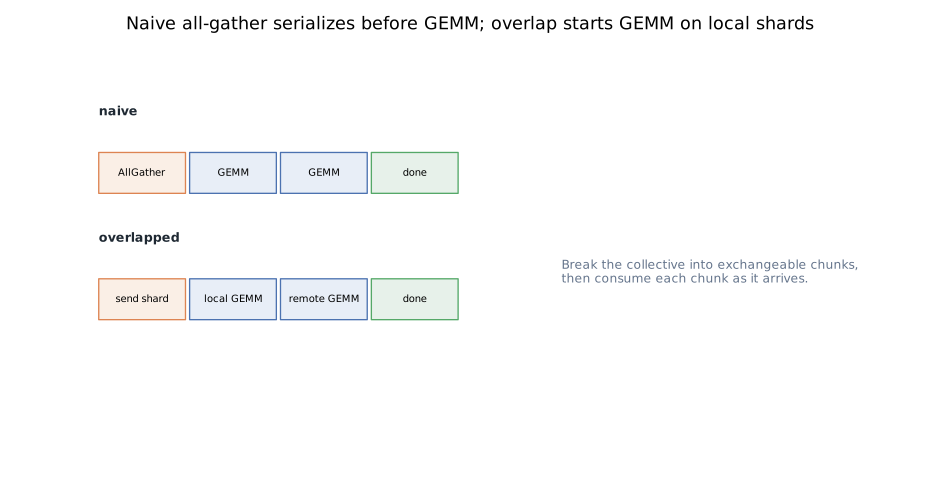
The dependency to respect is per chunk, not necessarily per full tensor. This is the core idea behind AllGather overlap.
3. P2P AllGather Overlap
In a P2P ring-exchange version, each rank starts with its local input shard. It immediately computes the partial GEMM for that shard. At the same time, it sends the shard to one neighbor and receives another shard from the other neighbor.
On the next iteration, the rank computes with the received shard while forwarding it onward. After enough iterations, every rank has computed the contribution for every input shard it needed.
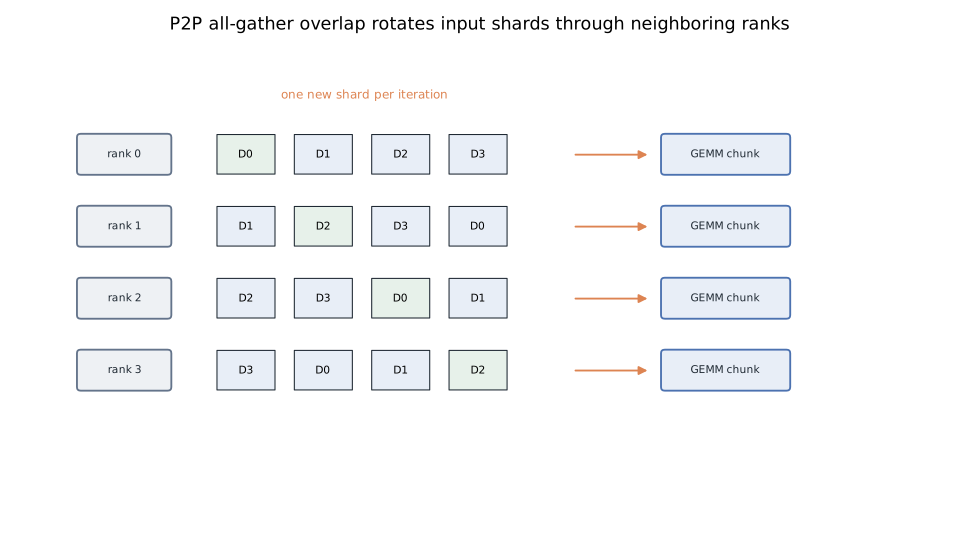
This turns a blocking collective into a pipeline:
The overlap succeeds only if the GEMM work per chunk is large enough to cover communication and scheduling overhead. If chunks are too small, the GPU spends time launching kernels and moving tiny messages. If chunks are too large, the first useful remote chunk arrives too late and overlap weakens.
The idea resembles Ring Attention’s K/V rotation, but the tensor and operation are different. Here the ring carries activation chunks for a tensor-parallel GEMM. In Ring Attention, the ring carries K/V blocks for blockwise attention.
4. Naive ReduceScatter
ReduceScatter shows up after row-parallel work.
Each rank has computed partial outputs.
The final output shard for rank i is the sum of all ranks’ contributions to that shard.
The naive schedule is:
- Compute the full local partial output.
- Run ReduceScatter.
- Wait for the reduced output shard.
Again, this is correct. Again, it leaves overlap on the table.
The useful observation is that output ownership is bucketed.
If a bucket is destined for rank i, every rank can add its local contribution to that bucket.
The bucket does not need to sit idle until the full local output is computed.
5. P2P ReduceScatter Overlap
The P2P ReduceScatter overlap is less intuitive than AllGather overlap. A helpful mental model is “the bucket moves, and each rank pours in its contribution.”
Each rank sends an output bucket around the ring.
When a rank receives bucket C_i, it computes or adds the part of its local contribution that belongs to C_i.
Then it forwards the bucket.
After the bucket has visited all ranks, it returns to its owner fully reduced.
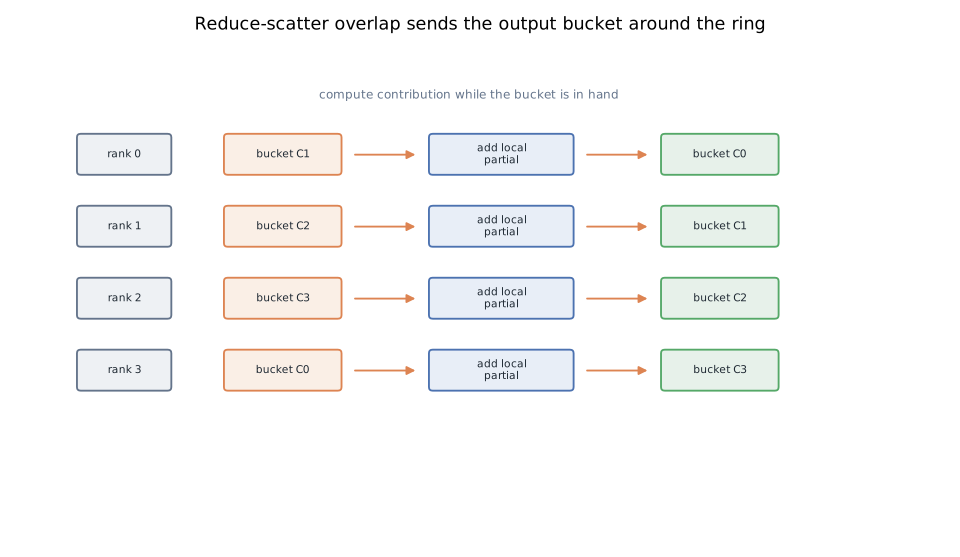
This is a distributed accumulation pipeline. The communication object is not just raw input data. It is a partially reduced output bucket with an owner.
The main implementation difficulty is ordering. The rank must not overwrite a bucket before downstream consumers are done. It must not read a contribution before the GEMM has produced it. And it must keep enough buffering to let communication progress without racing compute.
6. Pipeline-Chunk ReduceScatter
There is another ReduceScatter overlap pattern.
Instead of rotating buckets through a P2P ring, split the GEMM output into chunks.
As soon as chunk 0 is computed, begin ReduceScatter for chunk 0 while computing chunk 1.
Then repeat.
This is pipeline chunking. It is simpler to reason about than the moving-bucket mental model. It can work well when the output can be partitioned into a small number of substantial chunks.
The chunk count is a tuning parameter. Too few chunks expose communication. Too many chunks reduce GEMM efficiency and increase scheduling overhead. A default like four chunks is a compromise, not a law.
7. Bulk Overlap
Not every overlap opportunity is a direct “this collective feeds this GEMM” dependency. During backward, some communication is independent of the next compute on the critical path. For example, a data gradient GEMM may not need an activation AllGather that is required later for a weight gradient. That AllGather can sometimes start on a communication stream while the data-gradient GEMM runs on the main stream.
This is the bulk overlap case. It often involves pre-registered user buffers, a main compute stream, a communication stream, and careful event synchronization.
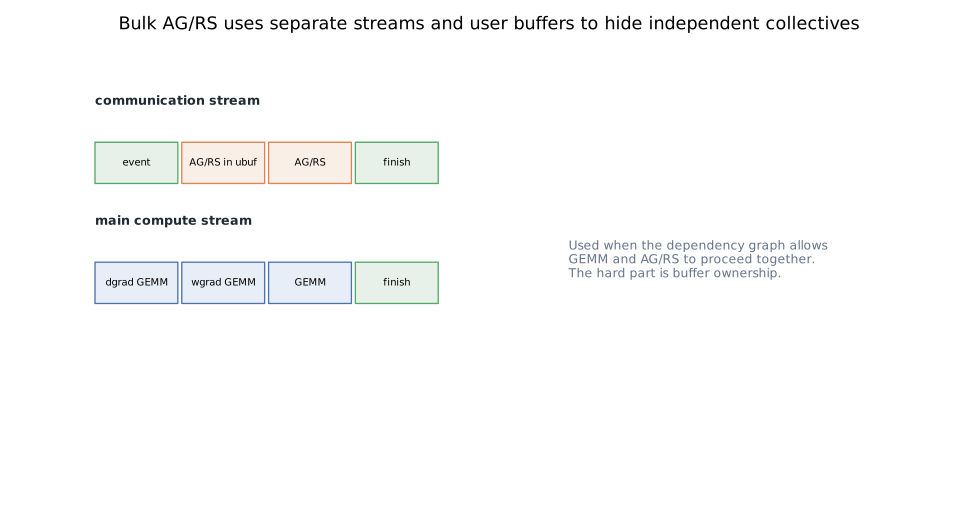
Bulk overlap sounds straightforward until buffer ownership enters the picture. The communication stream needs a stable source and destination. The compute stream must not mutate those buffers too early. The framework must coordinate stream waits without turning the whole thing back into a serial schedule.
This is why overlap flags can interact. Two individually valid overlap modes may compete for the same buffer or stream resources. Turning on every overlap option is not guaranteed to be faster.
8. Dependency Classes
A practical way to think about tensor-parallel overlap is to classify each collective.
The first class is producer-before-consumer. The GEMM cannot consume a remote chunk until that chunk has arrived. P2P AllGather overlap helps by making the dependency chunk-granular.
The second class is consumer-before-reduction. The ReduceScatter cannot reduce an output element until the local contribution exists. P2P or pipeline-chunk ReduceScatter helps by making the dependency bucket-granular.
The third class is independent side work. The collective is needed later, but not by the GEMM currently on the critical path. Bulk overlap helps by moving it to a communication stream.
Once you classify the dependency, the schedule becomes easier to reason about.
9. What to Look For in a Trace
A healthy overlapped AllGather should not look like one large communication block followed by one large GEMM block. It should look like smaller communication and GEMM regions interleaved or concurrent.
A healthy overlapped ReduceScatter should not wait for the entire output before any communication starts. You should see early communication begin before all compute in that region is complete.
Bulk overlap should show work on separate streams with meaningful concurrency. If CUDA events force the communication stream to wait until compute finishes, the mode is nominally enabled but effectively serial.
Also watch for tiny kernels and tiny messages. Overlap can reduce exposed communication while increasing launch overhead. The final metric is step time, not the presence of colorful trace lanes.
10. Relationship to Other Parallelism
Tensor-parallel collective overlap is a local performance optimization. It does not change the mathematical partitioning. It changes when communication happens relative to compute.
That makes it complementary to the rest of the LLM training stack:
- Megatron SP reduces activation memory but introduces AG/RS boundaries that need good scheduling.
- Megatron Context Parallel similarly relies on overlap, but for K/V exchange in long-context attention.
- ZeRO has its own gather and scatter patterns for model states, with different tensor ownership.
- Tensor parallelism still decides what each rank computes.
The common lesson is that collectives are not only bandwidth costs. They are dependency edges. Performance work is often the process of replacing one coarse dependency edge with several smaller ones that the GPU and network can run around.
Code
Useful code paths to read:
- Megatron-LM argument definitions: flags such as
tp_comm_overlapand related overlap controls. - Megatron-LM Transformer config: model-layer configuration that flows into Transformer Engine.
- Transformer Engine PyTorch module base: user-buffer initialization hooks such as
initialize_ub. - Megatron Bridge communication-overlap docs: practical presets and requirements for TP overlap.
When reading the code, keep buffer ownership separate from collective type. Most bugs are not “wrong collective”; they are “right collective, launched too late or using a buffer compute still owns.”
References
- Narayanan et al., Efficient Large-Scale Language Model Training on GPU Clusters Using Megatron-LM, 2021.
- Korthikanti et al., Reducing Activation Recomputation in Large Transformer Models, 2022.
- Code: NVIDIA Megatron-LM,
arguments.py, NVIDIA Transformer Engine,base.py, Megatron Bridge communication overlap docs.