From Scaling Laws to Cluster Size: Capacity Planning That Survives Contact With GPUs
Scaling laws tell you how loss should move with tokens and parameters. Clusters tell you what you can actually buy. Capacity planning is the bridge — and most teams skip it until the first failed launch burns a week of calendar time and a pile of GPU-hours.
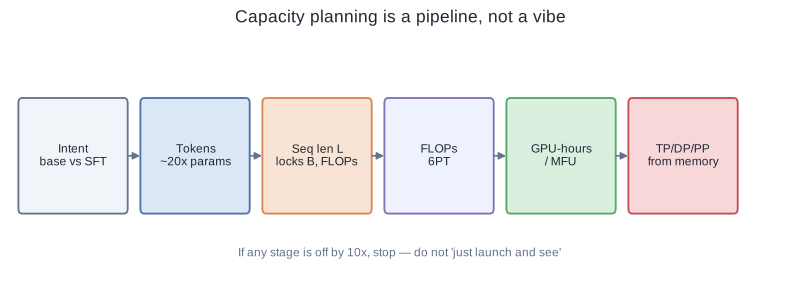
This post is a reproducible planning pipeline: tokens → steps → FLOPs → GPU-hours → forced parallelism. The arithmetic lives in playground/capacity_plan.py; the figures below are generated from its JSON output. Not exact. Accurate enough to catch 10× fantasy plans.
TL;DR
- Fix intent first (base vs SFT, context needs). Then
tokens ≈ 20 × paramsas a Chinchilla-style planning heuristic — not a law of physics. - Sequence length
Ldominates: it sets tokens/step, activation memory, and whether you need SP/CP. FLOPs ≈ 6PT, thenGPU-hours = FLOPs / (peak × MFU). Assume MFU 0.35–0.45, not brochure peaks.- Parallelism is forced: fit static state (weights + grads + optimizer) → TP/ZeRO → SP/CP for long context → PP last.
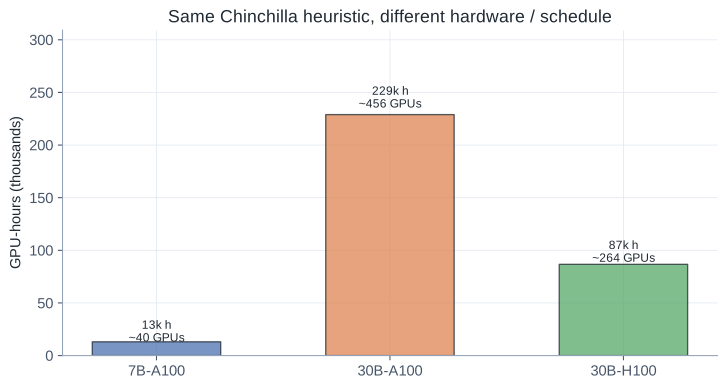
- Worked cases from the calculator (A100 BF16 planning): 7B ≈ 13k GPU-h; 30B ≈ 229k GPU-h (~$0.9M at $4/GPU-h) → ~456 GPUs for a 3-week wall-clock.
Step 1 — Intent, Not Hardware
Scaling laws do not choose the product. Fix:
- Base pretrain vs instruction / reasoning SFT
- Whether long context is a requirement or a résumé line
- Multimodal extras (vision tokens inflate effective sequence length — see SiQ curriculum)
Those choices lock token budget, L, and which parallelism tax you will pay.
Step 2 — Token Budget (Order of Magnitude)
| |
| Params | ~Token budget |
|---|---|
| 1B | 20B |
| 7B | 140B |
| 30B | 600B |
Production base models often overtrain past Chinchilla (Llama-class 1T+). For planning a resource-constrained run, 20× is the honest starting line. If you are off by 10×, stop.
Step 3 — Sequence Length Locks Everything
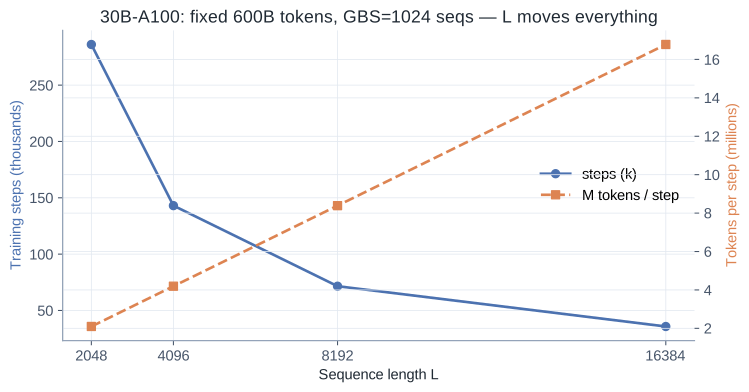
Attention FLOPs scale ~quadratically with L; activation memory roughly linearly with large constants; longer L shrinks sequences-per-step for a fixed token batch.
| Use case | Typical L |
|---|---|
| Classic LM | 2K–4K |
| Instruction / light reasoning | 4K–8K |
| Long-context / heavy multimodal | 8K–32K |
Step 4 — Tokens → Steps
| |
Example (30B case in the calculator): 600B tokens, L=4096, GBS=1024 sequences → ~143k steps. If that number does not feel either “long” or “impossible,” recheck inputs.
Step 5–6 — FLOPs → GPU-Hours
Decoder-only rule of thumb:
Use sustained MFU, not peak. The calculator defaults to ~0.40–0.42 on A100 BF16 and ~0.35 on a more communication-heavy H100 assumption.
| Case | Tokens | GPU-hours | Cluster for target | Est. $ @ listed rate |
|---|---|---|---|---|
| 7B · A100 · 14 days | 140B | ~13.1k | 40 GPUs (TP1×DP40, ZeRO-1) | ~$52k @ $4/h |
| 30B · A100 · 21 days | 600B | ~229k | 456 GPUs (TP4×DP114 w/ ZeRO-1) | ~$916k @ $4/h |
| 30B · H100 · 14 days | 600B | ~87k | 264 GPUs | ~$520k @ $6/h |
Raw JSON: capacity_plan_results.json. Re-run:
Step 7 — Memory Forces Parallelism
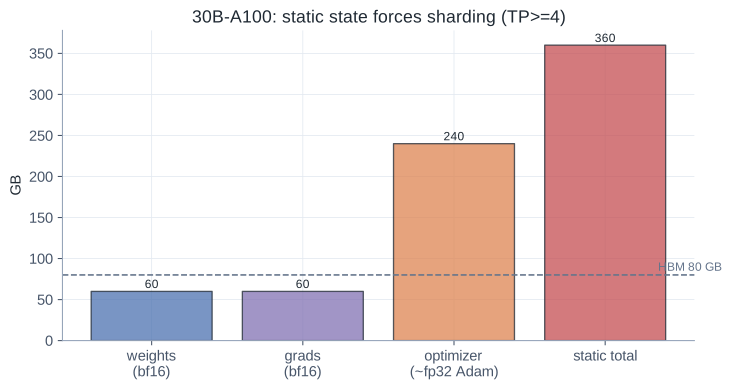
For 30B bf16 + AdamW-class state:
| Tensor | GB |
|---|---|
| Weights (bf16) | 60 |
| Grads (bf16) | 60 |
| Optimizer (~8 B/param) | 240 |
| Static total | 360 |
On 80 GB HBM that does not fit. TP (and/or ZeRO) is mandatory — preference is irrelevant.
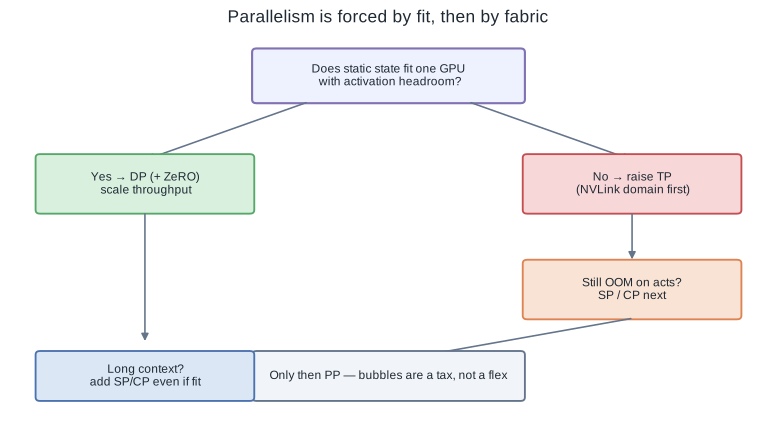
Order of attack:
- Fit weights → TP inside an NVLink domain (and ZeRO-1 to shard optimizer across DP).
- Fit activations / long L → sequence / context parallel.
- Scale throughput → DP.
- Only then pipeline parallel — bubbles are a tax.
For the 30B A100 case, naive static sharding wants high TP; ZeRO-1 lets the planner prefer TP=4 (two replicas per 8-GPU node) × DP across the cluster, PP=1. That matches the “keep TP on NVLink” instinct from MoE/MegaScale-style geometry: do not pay IB for matrix splits you can avoid.
Step 8 — Cluster Size From Wall-Clock
| |
Round to node multiples. Then ask the non-FLOP questions: can the fabric absorb AllReduce at that DP? Can storage survive checkpoint storms? Async / sharded checkpointing is part of the plan, not an afterthought — at 30B, a full state is hundreds of GB.
Step 9 — Staged Training Is Capacity Planning Too
Almost no serious run is one monolithic schedule:
- short
Lfirst, then extend - freeze towers / train projectors early (VLM)
- offline distillation stages before RL
Scaling laws set direction. Stages set whether you survive the first month.
Closing
If you can estimate tokens, FLOPs, memory, and a forced TP/DP/PP map on paper, you are ahead of “launch and see.” The calculator will not replace a profiler — see end-to-end profiling and Roofline once the job exists — but it will stop you from renting the wrong cluster for the wrong token budget.
Code: playground/capacity_plan.py · figures: playground/capacity_plan_figures.py