Foundation Model Kernel Optimization in 2026: A Field Guide Across Dense, MoE, Multimodal, and Diffusion
Most “kernel optimization” conversations still start with FLOPs. In 2026 that is usually the wrong first question. Foundation-model runtime is dominated by HBM traffic, KV cache, temporary tensors, collectives, dynamic permutation, and launch overhead. FlashAttention, fused linear–cross-entropy, paged KV, MoE grouped GEMM, and DeepEP-style dispatch all share one essence: do not materialize intermediates, or make each byte travel once.
This post is a field guide to the kernel / fused-kernel / collective families that matter on critical paths — Dense Transformers, MoE, LLM train/serve, VLM / audio / video, contrastive multimodal training, Diffusion / DiT, and SSM / long convolution — plus the communication, memory, layer-structure, and model–kernel co-design moves that decide whether a fast op shows up in end-to-end tokens/s.
Scope note. “Every kernel” here means families on the critical path, not every CUDA symbol in a framework. Batch, sequence length, hidden size, GPU generation, and parallel strategy spawn different instances; symbol-level enumeration is unstable and rarely useful.
Related posts on this blog: Roofline, GPU Optimization Playbook, Large MoE Performance, torch.compile, VLM one-GPU recipe.
TL;DR
- Optimize data movement first, not peak FLOPs. Fusion, paging, packing, and low precision win by cutting bytes and launches.
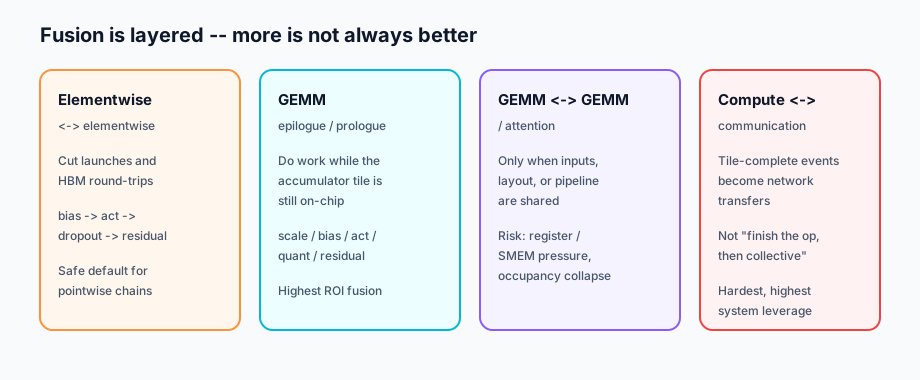
- Fusion is layered. Elementwise chains are cheap wins; GEMM epilogue fusion is the safe high-ROI boundary; GEMM↔GEMM and compute↔comm fusion need shared layout/pipeline and can hurt occupancy.
- Train ≠ prefill ≠ decode. Prefill is large-GEMM heavy; decode is GEMV / small-GEMM + KV bandwidth; training adds backward, optimizer, and cross-rank sync.
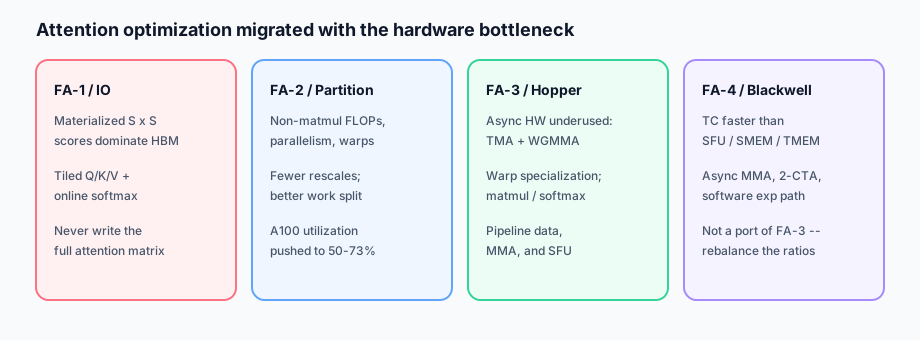
- Attention co-design is hardware-asymmetric. FA1 fixed IO; FA2 fixed work partition; FA3 used Hopper TMA/WGMMA; FA4 rebalances Blackwell Tensor Core / SFU / TMEM / 2-CTA ratios.
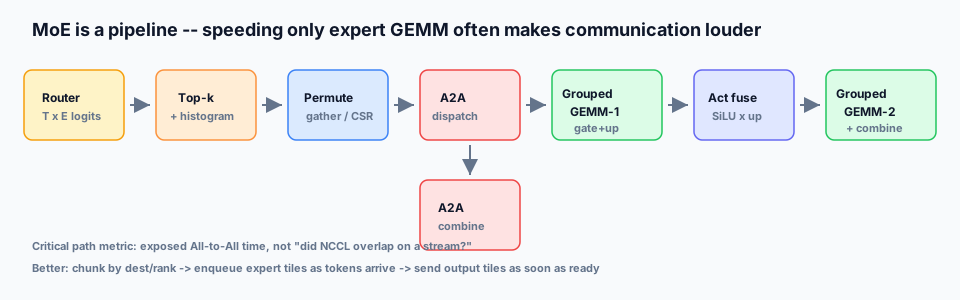
- MoE is a pipeline. Router → top-k → histogram → permute → All-to-All → grouped GEMM → act → combine. Speeding only expert GEMM often amplifies communication.
- Overlap needs finer dependencies than “another CUDA stream.” Chunk/tile/threadblock events beat whole-tensor collectives.
- Memory has six levers: dematerialize, compress, pack/page/layout, recompute, shard/offload/prefetch, allocator lifetime. Peak GB alone is a bad KPI.
- Multimodal’s biggest lever is usually token budget (native resolution, packing, temporal sparsity) — architecture–runtime co-design, not one vision kernel.
- Diffusion’s unique lever is cross-timestep redundancy (cache, fewer steps, CFG parallel) — fewer full-network calls, not only faster ops.
- End-to-end KPIs win. Kernel TFLOP/s without graph-break / layout / exposed-comm / p99 / quality checks is storytelling.
1. A practical performance model
For a kernel or path, a lower bound looks like:
- : useful FLOPs; is limited by Tensor Core use, tile choice, occupancy, dependency chains, SFU throughput.
- : bytes that actually cross HBM — materialization, cold KV, layout copies inflate this beyond logical tensor size.
- : NVLink / PCIe / IB bytes; topology, algorithm, message granularity, and congestion set effective bandwidth.
- Launch / sync / imbalance dominate small-batch, short-sequence, fine-grained MoE, and ragged workloads.
NVIDIA’s Nsight Compute Profiling Guide splits kernels into memory- vs compute-bound. Foundation models need two more axes: network and launch / load imbalance. For the arithmetic-intensity framing, see Roofline on this blog.
1.1 Symptom → direction
| Profiling symptom | Common root cause | Prefer | Easy trap |
|---|---|---|---|
| High DRAM, low Tensor Core | Bandwidth-bound; repeated intermediates | Fusion, in-place, low precision, reuse, packing | Oversized fusion → spill → more local-memory traffic |
| Low Tensor Core and low DRAM | Small shapes, launch-bound, SFU/deps, low occupancy | Persistent kernels, batch/group, Stream-K, CUDA Graph | Chasing occupancy alone |
| High Tensor Core but far from peak | Bad tiles, pipeline bubbles, wave quantization, tails | Autotune, split-K/Stream-K, warp specialization, async copy | Overfitting one benchmark shape |
| Many memcpy / layout kernels | Producer/consumer layout mismatch | Unified layout, prepack, transpose/quant in prologue/epilogue | Benchmarking only GEMM |
| Long NCCL, idle compute | Exposed collective | RS/AG split, chunk/tile overlap, topology, compression | Stream overlap with whole-tensor deps |
| NCCL and compute both slow | SM / L2 / HBM / NVLink contention | Cap comm CTAs, priority, double buffer, staged overlap | “More overlap is always better” |
| MoE expert GEMM long tail | Uneven tokens/experts; many tiny GEMMs | Grouped GEMM, block-sparse, persistent schedule, balancing | Capacity padding waste; sort becomes bottleneck |
| Decode slows linearly with context | KV bandwidth / capacity | GQA/MQA/MLA, paged/quantized KV, split-KV decode | Swapping only the prefill FlashAttention kernel |
| High peak memory, moderate HBM BW | Overlapping activation / logits / workspace lifetimes | Selective recompute, chunked loss, buffer reuse | Full checkpoint everywhere |
2. A dictionary of techniques
| Technique | Dataflow essence | Typical targets | When it pays |
|---|---|---|---|
| IO-aware tiling | Keep working set in register / SMEM / LDS / TMEM | Attention, GEMM, FFT conv | Arithmetic intensity available but materialization kills it |
| Multistage pipeline | Overlap async load / MMA / epilogue | GEMM, attention | Large stable tiles; cp.async / TMA available |
| Warp specialization | Split producer / consumer / softmax / epilogue | Hopper/Blackwell attention & GEMM | One warp juggling copy+compute creates bubbles |
| Vertical fusion | Merge consecutive ops | bias→act→dropout→residual→norm | Pointwise/reduction with large intermediates |
| GEMM epi/prologue fusion | Scale/bias/act/quant/residual while tile is on-chip | Linear, MLP, projectors, DiT | GEMM followed by low-intensity ops |
| Horizontal fusion | Share one input read across ops | QKV, gate+up, multi-LoRA | Shared HBM/L2 traffic |
| Persistent kernel | Resident CTAs pull tiles/tasks from a queue | Small/heterogeneous GEMM, decode, MoE | Launch / wave quantization / dynamic schedule dominate |
| Split-K / Stream-K | Partition K or iteration space, then reduce | Skinny GEMM, decode attention | Small M/N underfills SMs; pay partial reduction |
| Layout / prepack / swizzle | Coalesced global→shared→MMA path | INT4/FP8 GEMM, KV, MoE | Offline weight rearrange; amortize conversion |
| Lower precision | Fewer bytes + higher TC throughput | FP8/FP4/INT8/INT4, KV | Native scale/dequant kernels for the target shape |
| Sparsity | Skip zero / unimportant blocks | Local/sparse attention, MoE, video | Block-structured; index cost < savings |
| Packing / ragged | Kill padding via offsets / cu_seqlens | NLP / VLM / audio / video | Large length/resolution variance |
| Paging | Fixed pages + indirection | KV cache, LoRA adapters | Dynamic serving; unpredictable lengths |
| Recomputation | Drop cheap intermediates; recompute in bwd | Attention stats, activations | Capacity-bound and recompute FLOPs are cheap |
| Compute–comm overlap | Finer tile/chunk dependencies | TP / FSDP / EP / CP | Large enough comm with independent compute windows |
| Architecture co-design | Shrink state, tokens, branches, interaction range | GQA/MLA, NSA, SigLIP, TeaCache | Kernels near hardware limits; change the problem |
2.1 Different GPU generations want different “good” kernels
| Platform | Critical primitives | Kernel design focus |
|---|---|---|
| NVIDIA A100 / SM80 | Tensor Core, cp.async, shared memory | Warp-level MMA, multi-stage copy/compute, FA1/FA2 + classic CUTLASS |
| NVIDIA H100 / SM90 | TMA, WGMMA, clusters, warp-groups | Producer/consumer specialization, TMA descriptors, async WGMMA; FA3 / CUTLASS 3.x — see Hopper Tuning Guide |
| NVIDIA B200/GB200 / SM100 | tcgen05.mma, TMEM, 2-CTA MMA, FP4/FP6/FP8 | Accumulators in TMEM, single-thread MMA issue, dual-CTA tiles; rebalance TC vs SFU/SMEM — CUTLASS tcgen05, FA4 |
| AMD MI300X/MI350 | MFMA, LDS, HBM, XCD/L2, hipBLASLt/CK/RCCL | Wavefront/LDS banks, MFMA tiles, XCD/NUMA + RCCL topology; Triton ports need re-autotune — ROCm workload tuning |
Do not copy H100 block sizes, warp counts, and stage counts onto B200 or MI300X. Tensor Core throughput often outruns SFU, register bandwidth, SMEM, and the network — the non-matmul and orchestration paths become the new Amdahl bottleneck.
3. Dense Transformer / LLM / sequence kernels
Notation: B batch, S sequence, H hidden, V vocab, D head dim. Covers train fwd/bwd, prefill, decode, loss, optimizer.
| ID | Kernel / path | Main bottleneck | How to optimize | Co-design & references |
|---|---|---|---|---|
| T01 | Linear / GEMM (fwd, dgrad, wgrad) | Large shapes compute-bound; skinny/tail under-utilized; epilogue BW | Hierarchical tiles; async global→SMEM; TC MMA; double buffer; warp specialization; CTA swizzle; Stream-K/split-K; bias/act/scale/quant/residual epilogue fusion; shape autotune | CUTLASS efficient GEMM, Stream-K, Triton matmul, CODA |
| T02 | Decode Linear / GEMV / small GEMM | Re-read weights every token; tiny M; launch-bound | Weight-only INT4/FP8; continuous batching; persistent tile scheduler; vectorized loads; L2 reuse of activations; dequant interleaved with MMA | Marlin (prepack + async load + dequant–MMA overlap) |
| T03 | QKV projection | Triple read of X; three launches; layout conversion | Fuse weights into one GEMM; shared X; fused bias; write packed/head layout attention wants; optional Q/K RoPE + KV quant/update in epilogue | Decode: fuse KV cache update; different Q/K/V dtypes or TP shards can make forced fusion worse |
| T04 | RoPE / M-RoPE | Elementwise; sin/cos traffic; extra transpose | Vectorized pair rotation; sin/cos cache; in-place; fuse into QKV epilogue or attention prologue; inverse rotate in bwd | Liger Kernel; VLM M-RoPE in Qwen2-VL |
| T05 | Dense attention prefill fwd | S² score/prob materialization | Tile Q/K/V; online softmax; keep score/prob in register/SMEM; causal/local mask inside tile; store LSE only; TMA/WGMMA pipeline; FP8 block scale | FA1 → FA2 → FA3 → FA4 |
| T06 | Attention backward | Multi-pass dQ/dK/dV; recompute; atomics; imbalance | Recompute probs from saved LSE (not S²); retile; split dQ vs dK/dV; sequence/head parallel; deterministic mode costs extra buffers | Fastest forward is not always lowest fwd+bwd |
| T07 | Decode attention (q_len≈1) | Read full K/V; memory-bound; ragged batch | Page/block-aware loads; split-KV across CTAs + small reduce; GQA-aware; dynamic load balance; JIT page size/head dim/mask; fuse LSE | FlashInfer, flash-attention KV path |
| T08 | KV append / gather / quant | Noncontiguous pages, metadata, capacity | Fuse append with RoPE/attention; compact page tables; vector gather; choose K/V interleave by access pattern; block-scaled FP8/INT8/INT4 KV; prefix page sharing | PagedAttention / vLLM; vAttention on paging costs |
| T09 | GQA / MQA / MLA | KV bytes dominate decode | Share KV across Q heads; reuse KV tiles across CTA/warp; MLA compresses to low-rank latent | MQA, GQA, DeepSeek-V2 MLA — model cuts bytes first |
| T10 | Sparse / local / block attention | Irregular index; low occupancy | Block-sparse / fixed windows; tile indexes; skip empty tiles; compaction + grouped schedule; avoid token-level branches | Native Sparse Attention, Faster Neighborhood Attention |
| T11 | Softmax / masked softmax | Exp/reduction + HBM; SFU limits | On-chip per row/tile; online max/sum; warp shuffle; fuse mask/bias/scale; two-stage for long rows; skip negligible blocks when safe | Triton fused softmax; Skip Softmax in TensorRT-LLM |
| T12 | RMSNorm / LayerNorm | Two reductions + R/W; small-H launch-bound | Single-CTA / multi-warp row reduce; vector loads; Welford or sum-of-squares; fuse residual/cast/quant/linear prologue | Triton LayerNorm, Transformer Engine normalization, Liger |
| T13 | Bias + dropout + residual + stochastic depth | Pointwise HBM round-trips; mask memory | One load/store fuse; counter-based RNG; store seed/offset or recompute mask; merge with norm or GEMM epilogue | Triton low-memory dropout |
| T14 | GELU / SiLU / SwiGLU / GeGLU | Large gate/up intermediates; SFU | Horizontal fuse gate+up GEMM; SiLU×up in epilogue; validate approximations; recompute in bwd | Liger, CODA — megakernels can kill occupancy |
| T15 | Embedding gather / scatter bwd | Irregular reads; atomics on repeats | Vectorized gather; align vocab rows; fuse scale/position/type adds; sort/dedup or warp-local aggregate before atomic | Often small, but short sequences + huge vocab/optimizer matter |
| T16 | LM-head / logits GEMM | Huge B·S × V output; skinny decode GEMM | Vocab parallel; split/Stream-K; compute only needed tokens; low-precision weights; do not materialize logits — stream tiles into online LSE/loss | Cut Cross Entropy, Liger fused linear CE |
| T17 | Cross-entropy / LSE bwd | O(BSV) logits/prob memory | Vocab chunk; online max/sum; fuse loss / z-loss / label smoothing / grad; save per-token LSE; recompute local logits in bwd | Cut Cross Entropy reports 24 GB→1 MB loss memory on one Gemma2-2B setup — shape-dependent |
| T18 | Sampling (temp / top-k / top-p / multinomial) | Large-V sort/scan; many launches | Fuse logits→softmax→filter→sample; rejection sampling vs full sort; CUB/warp scan; device-side RNG; speculative accept/reject fuse | FlashInfer sampling post, API |
| T19 | LoRA XAB + base linear | Many small GEMM/GEMV per adapter | SGMV/BGMV by adapter segment; rank buckets; A/B prepack; fuse scale+add into base epilogue; page adapters with KV | Punica, S-LoRA |
| T20 | Quant / dequant / scale / swizzle | Conversion eats low-precision wins | Quant in producer epilogue; dequant in consumer mainloop; align block/token/channel scales to MMA tiles; fuse amax reductions | TE FP8 primer, blockwise scaling |
| T21 | Grad accumulation / multi-tensor scale/norm/clip | Thousands of tiny tensors | Multi-tensor apply; merge scale/unscale/finite/norm/clip; accumulate FP32 wgrad buffers; bucket with communication | TE advanced optimizations |
| T22 | Adam / AdamW / SGD | Param/grad/m/v/master multi-pass HBM | Multi-tensor fused update; 8-bit blockwise state; stochastic rounding; shard/offload; lazy/step fusion | Apex FusedAdam, 8-bit optimizers, FlashOptim |
| T23 | SSM selective scan / Mamba | Recurrence; expanded state; small-op chains | Chunk/parallel scan; keep state on-chip; fuse proj/conv/gate/scan; recompute in bwd; Mamba-2/SSD rewrite chunks as matmul | Mamba, Mamba-2/SSD, official impl |
| T24 | Long / FFT convolution | FFT transpose/complex intermediates | Map FFT factors to TC matmul; fuse FFT×pointwise×iFFT; length buckets; packed masks; precompute kernel FFT | FlashFFTConv, RubiConv |
3.1 What “fuse elementwise and GEMM” actually means
The safe high-ROI boundary is usually the GEMM epilogue. For Y = act(XW + b) * gate + residual:
- Mainloop accumulates
XWon Tensor Cores. - While the accumulator tile is still in register/TMEM, add bias/scale.
- Apply activation, gate, residual, dtype convert / quant.
- Write final
Yto HBM once.
That avoids three-to-four large intermediates. On Blackwell, accumulators live in TMEM, so epilogue traffic and SFU scheduling differ from Hopper; CODA goes further and expresses many non-attention Transformer ops as GEMM + epilogue programs.
Do not fuse blindly when:
- Per-thread registers explode into spills;
- Ops want incompatible tiles / parallel axes;
- Reductions need cross-CTA sync;
- One producer fans out to many consumers (fusion duplicates work);
- Dynamic shapes explode JIT variants;
- Backward recompute turns a compute-bound path slower.
3.2 Four generations of FlashAttention
| Generation | Binding constraint | Core move | Notes |
|---|---|---|---|
| FlashAttention-1 | S×S HBM IO | Tiled Q/K/V + online softmax | Algorithmic IO-awareness; no full attention matrix |
| FlashAttention-2 | Non-matmul FLOPs, parallelism | Fewer rescales/bounds checks; better block/head parallel & warp partition | Paper reports ~50–73% of theoretical FLOPs on A100 |
| FlashAttention-3 | Underused Hopper async HW | TMA producer + WGMMA consumer; warp specialization; matmul/softmax interleave; FP8 | Pipeline movement, MMA, SFU |
| FlashAttention-4 | Blackwell TC ahead of SFU/SMEM; TMEM / 2-CTA | Fully async MMA; larger tiles; software exp / conditional rescale; TMEM; 2-CTA MMA | Author notes ~1.6 PFLOP/s BF16 (~71% peak) on specific configs — see Tri Dao’s FA4 post |
Lesson: when one resource gets faster, the bottleneck moves. FA4 is not “FA3 ported to Blackwell”; it rewrites the schedule around new resource ratios.
4. MoE: optimize the whole token–expert pipeline
With T tokens, E experts, top-k=K, MoE cost is not “K expert MLPs.” It includes T×E router logits, top-k, counts/offsets, permute, cross-rank dispatch/combine, imbalance tails, and the backward inverse path. For the systems framing of memory / communication / compute walls, see Large MoE Performance on this blog.
| ID | Kernel / path | Main bottleneck | How to optimize | Co-design & references |
|---|---|---|---|---|
| M01 | Router linear | Mid/small GEMM; large T×E | Low-precision GEMM carefully; fuse bias/temperature; keep only top-k stats; shard-aware outputs | Keep higher accumulation precision; DeepSeek-V3 aux-loss-free balancing |
| M02 | Top-k / gate softmax | Per-token sort/reduction | Warp/block selection without full sort; specialize k∈{1,2,8}; fuse softmax+top-k+renorm | Small E: one CTA; large E: hierarchical top-k |
| M03 | Histogram / prefix-sum / capacity | Atomics; multi-pass; CPU sync | Warp-local hist → merge; fuse scan/offsets; device-side capacity/drop; persistent queues | Capacity padding simplifies GEMM, wastes FLOPs |
| M04 | Token permute / gather / scatter | Noncontiguous HBM; full copies | Blocked CSR/COO; vector gather; fuse gate/quant; emit grouped-GEMM-ready layout; reuse inverse map in bwd | MegaBlocks, ScatterMoE |
| M05 | Expert dispatch All-to-All | Small messages; cross-node; sync | Locality-aware routing; FP8 dispatch+scale; NVLink/IB hierarchy; low-latency vs high-throughput kernels; async events; double buffer | DeepEP |
| M06 | Expert GEMM-1 (gate/up) | Heterogeneous small M; launches | Grouped GEMM; persistent CTAs; token-count buckets; horizontal gate+up; L2 reuse | DeepGEMM, TritonMoE, LigerExperts |
| M07 | Expert activation / gate | Large T·K·ffn intermediates | Fuse SiLU×up into GEMM-1 epilogue or GEMM-2 producer pipeline; recompute in bwd | TritonMoE reports ~35% related traffic cut on their fused path — paper-specific |
| M08 | Expert GEMM-2 + local combine | Uneven GEMM; scatter + gate mul | Grouped/persistent GEMM; epilogue×gate; scatter-add to token order; warp-local accumulate; on-chip merge of same-token top-k | ScatterMoE ParallelLinear; SonicMoE on IO-aware tiles |
| M09 | Combine All-to-All | Inverse permute + network + sum; waits on slow experts | Send as output tiles ready; fuse gate/reduce/scatter after recv; aggregate by source rank | Topology and token distribution often beat single-GPU kernels |
| M10 | Load balance / drop / shared expert | Slow expert sets step tail | Device-side counts; online routing bias; expert replication; shared+routed in parallel; global batch balance | DeepSeek-V3 + DualPipe are co-design outside the kernel |
| M11 | MoE backward | Inverse permute, grouped dX/dW, gate grad, two A2As | Compact route metadata; recompute acts; persistent/grouped wgrad; overlap dgrad with A2A | Forward-only benches mislead training ROI |
| M12 | MoE mega / fused kernel | Launch / writeback / sync at boundaries | Partial megakernels; SM/CTA specialization for comm vs compute; tile queues/barriers | Comet, FLUX, UniEP |
4.1 The right overlap granularity
Bad: full dispatch → all expert GEMMs → full combine.
Better:
- Chunk tokens by destination / rank / expert.
- Enqueue grouped-GEMM tasks as chunks arrive.
- Push completed output tiles into the combine send queue immediately.
- Specialize communication vs compute CTAs (or event-driven streams/communicators).
- Cap communication CTAs so they do not steal all SM/L2/HBM.
FLUX decomposes then re-fuses communication and computation at fine tiles (paper: up to ~96% communication hidden in some settings). Comet uses threadblock specialization to balance resources. The KPI is exposed communication on the critical path, not “did the NCCL kernel overlap.”
4.2 Megatron-Core MoE map (flags change by version)
As of mid-2026, Megatron-Core 0.17 MoE is a combinator of routing, dispatcher, parallel map, precision, fusion, overlap, and memory strategies. Authoritative sources: Megatron-Core 0.17 MoE docs and NVIDIA’s 2026 MoE tech report.
| Layer | Choice / flag | What changes | When / caveats |
|---|---|---|---|
| Router topology | --moe-router-topk; group top-k via --moe-router-num-groups, --moe-router-group-topk | Group top-k aligns routing with node/rack/expert groups | Cuts cross-domain traffic; constrains expert choice — train with placement |
| Router probability | --moe-router-score-function softmax/sigmoid; --moe-router-dtype fp32 | Gate normalization and numeric path | Docs recommend FP32/FP64 router logits at high expert counts |
| Load balance | aux_loss, seq_aux_loss, global_aux_loss, sinkhorn, aux-loss-free dynamic bias | Changes routing distribution and sync needs | Global balance needs cross-rank stats; aux-loss-free still updates bias state |
| Dropless / capacity | --moe-expert-capacity-factor, --moe-pad-expert-input-to-capacity | Dropless = dynamic shapes; capacity = fixed/pad/drop | Capacity helps CUDA Graph; dropless needs p99 expert-load awareness |
| AllGather dispatcher | --moe-token-dispatcher-type allgather | Gather then local select — no classic token A2A, lots of activation replication | TP-only / small EP / large top-k; blows up as EP grows |
| NCCL All-to-All | --moe-token-dispatcher-type alltoall | Tokens only to target expert ranks | Standard EP; small-message / cross-node / dynamic-count costs |
| Flex + DeepEP | --moe-token-dispatcher-type flex --moe-flex-dispatcher-backend deepep | Drop cross-node redundant tokens; fused overlap | Fine-grained cross-node MoE on H100/B200 |
| Flex + HybridEP | --moe-flex-dispatcher-backend hybridep | TMA / IBGDA; fewer SM for comm; MNNVL/NVL72 paths | Strongly bound to GB200 NVL72-class hardware |
| Expert compute | --moe-grouped-gemm; TE GroupedMLP; FP8/MXFP8 | One grouped/persistent schedule over heterogeneous M | Essential for fine-grained experts |
| Router / permute fusion | --moe-router-fusion, --moe-permute-fusion | Collapse router/top-k/aux stats and permute/unpermute/gate paths | Verify numeric modes and FP8 route maps end-to-end |
| Shared expert | --moe-shared-expert-intermediate-size (+ --moe-shared-expert-overlap) | Dense shared MLP per token; can overlap with routed A2A | Changes model FLOPs/params — not a free kernel win |
| EP A2A batch overlap | --overlap-moe-expert-parallel-comm --delay-wgrad-compute | Merge adjacent µbatch fwd/bwd; split dgrad/wgrad for longer hide windows | Schedule/dependency optimization, not a faster collective |
| MoE Parallel Folding | Attn TP×CP×DP×PP vs MoE ETP×EP×EDP×PP | Decouple process-group maps | Parallel Folding |
| FP8 / MXFP8 | Hopper blockwise FP8; Blackwell MXFP8; route-map padding flags | Cut activation/dispatch/param-AG bytes; pad route maps to MMA alignment | Router usually stays high precision |
| Fine-grained recompute / offload | --recompute-modules …, --fine-grained-activation-offloading | Drop/recompute or D2H specific submodules | Prefer cheap large moe_act; full MoE recompute repeats A2A |
| CUDA Graph | Fixed capacity or --cuda-graph-scope attn | Dropless shape instability vs launch savings | Do not pad huge token counts just for graphs |
| Dense→MoE upcycling | --moe-use-upcycling, granularity flags | Split/copy dense FFN into experts from a checkpoint | Training/init strategy — reshapes grouped GEMM and comm ratios |
Recommended triage order: model semantics → parallel mapping (keep EP×ETP on NVLink/MNNVL; fold Attn vs MoE) → dispatcher → GroupedGEMM + router/permute fusion + FP8 recipe → shared-expert / batch A2A overlap / CUDA Graph / recompute-offload (ablate — contention is common).
5. Cross-rank communication, parallelism, and scheduling
| ID | Path | Bottleneck | How to optimize | Systems / notes |
|---|---|---|---|---|
| C01 | AllReduce (TP/DP) | Large messages; sync; topology | Ring vs tree; NVLS/NVLSTree/CollNet; bucket; RS+AG decomposition; topology-aware ranks | NCCL env / algorithms |
| C02 | ReduceScatter | Grad / row-col parallel outputs | Chunk pipeline; RS as soon as compute tiles finish; low-precision comm + high-precision accumulate | Often more natural than full AR for TP/FSDP |
| C03 | AllGather | Next-layer params/acts; peak memory | Prefetch next FSDP unit; consume by chunk; double buffer; swizzle before consumer | Megatron-FSDP: overlap often keeps two units resident |
| C04 | TP linear overlap | Coarse GEMM↔AG/RS deps | Slice sequence/batch/M/N; independent streams; overlap dgrad RS with wgrad GEMM | Megatron TP config |
| C05 | FSDP/ZeRO AG + grad RS | Per-layer traffic vs capacity | Layer/unit prefetch; flat buffers; stream separation; optimizer shard/offload | ZeRO, ZeRO++ |
| C06 | Pipeline P2P | Bubble; activation bytes | 1F1B / interleaved; virtual stages; µbatch tune; overlap P2P; activation quant | PTD-P |
| C07 | Context / sequence parallel attention | Cross-rank KV/acts | Ulysses A2A head↔sequence; Ring Attention streaming KV; USP combinations; overlap ring with tiles | Ulysses, Ring Attention, USP, DistFlashAttn |
| C08 | MoE All-to-All | See M05/M09 | Hierarchical A2A; node-limited routing; FP8; chunk overlap | EP scale-up is often sublinear once IB dominates |
| C09 | Fused compute + collective | Op-boundary HBM/sync | Tile-complete reduce/send inside GPU kernels; fused AllReduce–RMSNorm; persistent distributed queues | Fused communication, TokenWeave, TileLink |
| C10 | Graph launch / runtime | Hundreds of µkernels; CPU dispatch | CUDA Graph; torch.compile regions; persistent megakernels; shape buckets; device-side schedulers | torch.compile; FlashInfer load-balanced scheduler |
| C11 | Cross-op / multi-GPU persistent megakernel | Per-op barriers and HBM edges | Lower graph to SM-level tile graph; software pipeline across ops; in-kernel communication | Mirage Persistent Kernel, ParallelKittens — high engineering cost |
5.1 Four levels of overlap
| Level | Practice | Can it hide communication? |
|---|---|---|
| L0 Sequential | Collective after GEMM finishes | No |
| L1 Stream overlap | Whole-tensor collective | |
| L2 Chunk overlap | Slice tensor; communicate chunk i while computing i+1 | Usually best ROI; Megatron / Domino-style |
| L3 Tile / CTA fusion | Communicate as tiles complete; specialize CTAs | Finest grain; hardest; most hardware/topology bound |
Domino splits tensors and batches into independently advancing pieces. Measure with Nsight Systems:
Do not sum stream durations. Contended NCCL kernels can look “longer” while the critical path shortens.
6. Multimodal: vision, audio, video, fusion
Three layers matter:
- Input pipeline — decode, resize, crop, normalize, resample, STFT/mel: GPU/HW decode, async prefetch, fewer layout copies.
- Modality encoders — mostly Transformer/conv kernels, but token count, window/spatiotemporal sparsity, and ragged packing dominate.
- Fusion & losses — projectors/resamplers, cross/joint attention, contrastive similarity, generative LM loss: kill padding, avoid
B²/S²materialization, reduce global sync.
| ID | Path | Bottleneck | How to optimize | Co-design & references |
|---|---|---|---|---|
| V01 | JPEG/PNG/video decode | CPU serial; host copies | GPU/NVJPEG / HW decoder; decode+crop; pinned + async prefetch; resolution buckets | DALI image_crop decoder |
| V02 | Resize / crop / color / normalize / HWC↔CHW | Many BW-bound passes | Fuse crop-resize-normalize-cast-layout; vectorized loads; emit model dtype/layout | Keep decoder output layout aligned with patch embed |
| V03 | Patchify / patch embedding | unfold/im2col materialization | Strided Conv2D / implicit GEMM; fuse normalize/cast; channels-last; CLS/pos in epilogue | ViT; cuDNN Graph API |
| V04 | 2D/3D RoPE / vision PE | Coord gen + elementwise | Precompute/compress coords; vectorized rotations; fuse into QK / attention prologue | Qwen2-VL M-RoPE |
| V05 | Global vision attention | Many image tokens; ragged resolutions | FlashAttention varlen; packing + cu_seqlens; tile masks; fused QKV; CP for long images | NaViT; NeMo packed sequence |
| V06 | Window / neighborhood attention | Partition/reverse copies; small mats | No window materialization; address calc in-kernel; window BMM; fuse shift/mask | Neighborhood Attention, Faster NA |
| V07 | Token prune / merge / pool | Selection/reindex overhead | Block/warp top-k; compaction + prefix sum; fixed budgets; consume compact layout next layer | Worth it only if later layers shrink — prune at layer ends |
| V08 | Dynamic resolution / multimodal packing | Padding to max image/video | Pack by token budget; varlen offsets; resolution buckets; packed attention isolation; joint loss/position metadata | Qwen2-VL, Qwen2.5-VL, Open-Qwen2VL, VeOmni |
| V09 | Vision/audio projector | Ragged inputs; layout copies | Pack then one large GEMM; fuse gate+up/norm; write LLM embedding layout; FP8 | Layout/padding often cost more than the GEMM |
| V10 | Resampler / Q-Former / Perceiver | Cross-attn over many modality tokens | Fixed latent queries; IO-tiled cross-attn; cache K/V; fixed latent count for CUDA Graph | Pay one cross-attn to shrink every later LLM layer |
| V11 | Cross-modal / joint attention | Heterogeneous lengths; complex masks | Tile-local block masks; modality-specific RoPE/bias fused; cache static-modality K/V | Early fusion raises interaction and S²; late/cross-attn enables KV cache |
| V12 | CLIP-style similarity GEMM | Global embedding AllGather; B_global² | Fuse normalize+cast; overlap AG with local similarity tiles; 2D tiling; do not store full pairwise matrix | Global negatives couple objective and communication |
| V13 | Contrastive softmax / sigmoid loss | Row/col LSE; B² logits | Chunked online LSE; stream similarity tiles into loss; recompute tiles in bwd | SigLIP pairwise sigmoid changes global-norm needs — negatives still matter |
| V14 | Mixup / CutMix / random erase | Host/device round-trips | Fuse with decode/normalize; device RNG; in-place; sync label mix | Heavy aug can dominate step time |
| V15–V17 | Audio decode / STFT / mel / CMVN | Variable length; FFT plans; sparse mel | GPU decode; length buckets; batched cuFFT; fuse window→mag→mel→log; Welford CMVN | DALI ops, spectrogram example, mel filter bank |
| V18 | Audio subsample conv / encoder attn | Ragged padding; long audio attn | Packed/bucketed conv; channels-last; varlen FA; chunked/streaming KV | Streaming fixed chunks stabilize shapes, change receptive field |
| V19 | CTC / RNN-T DP loss | T×U×V state | Log-space scan; keep DP frontier only; chunk vocab projection; length buckets; recompute bwd | NVIDIA CTC/WFST memory note |
| V20 | Video tubelet / 3D patch embed | 3D decode/resize; token explosion | Tubelet Conv3D implicit GEMM; temporal stride; packed tokens | Temporal/spatial stride is first-order token co-design |
| V21 | Video temporal/spatial attention | (T·H·W)²; cross-frame redundancy | Factorized / window / block sparse; KV/feature cache; FP8+structured sparsity tiles; CP; frame/patch prune | FPSAttention, video sparse attention |
6.1 Multimodal priority is usually tokens, not patch kernels
Approx. VLM cost with visual tokens : per-layer linear ~, global attention ~.
- 2× faster patch embedding touches one shallow op.
- 2× fewer cuts linear, attention, activation, KV, and communication on every later layer.
- Removing 40% padding via packing compounds the same way without changing semantics.
That is why NaViT native-resolution packing, Qwen2-VL dynamic resolution, resampler latents, and video spatiotemporal sparsity so often beat an isolated CUDA micro-optimization. Practical one-GPU stacking notes: Optimizing VLM Training on One GPU.
7. Diffusion, DiT, U-Net, generative video
Diffusion’s distinctive structure is “the same denoiser, many times.” Optimize reuse across timesteps, solver step count, CFG branching, and cross-device patch/pipeline — not only per-step kernels.
| ID | Path | Bottleneck | How to optimize | Co-design & references |
|---|---|---|---|---|
| D01 | Text encoder / conditioning | Repeated across steps | FA / fused MLP; cache prompt embeddings/KV; batch prompts; cache negative prompts | Do not re-run text encoder every denoising step |
| D02 | U-Net Conv2D/Conv3D | Large feature-map BW; workspace | cuDNN/MIOpen autotune; NHWC; TC conv; implicit GEMM; conv+bias+act fuse; reuse skip buffers | cuDNN Graph API |
| D03 | GroupNorm + SiLU + scale/shift | Reduction + pointwise chatter | Single-CTA/warp group reduce; fuse norm+affine+SiLU + conditioning scale-shift | Many small ops; total share is large |
| D04 | ResBlock / skip concat | Feature copies; concat materialization | Fuse residual with norm/act; view/offset concat or dual-source next conv; careful in-place | Checkpoint high-res blocks first |
| D05 | U-Net self/cross attention | High-res tokens; repeated steps | FA/SDPA; fused QKV; cache prompt K/V; window/local; attention slicing only if capacity-bound | Conditioning cacheable; Q from changing features is not |
| D06 | DiT / MMDiT linear + attention | Many image/video tokens; multimodal weights | Reuse T01–T14; FA; gate+up; FP8/FP4; CP; joint attention masks; patch packing | DiT, SD3 / MMDiT |
| D07 | AdaLN / modulation | Many elementwise passes from timestep/cond | Batch small modulation GEMMs; fuse norm+modulation+residual gate | High frequency in DiT — excellent vertical fusion target |
| D08 | Timestep / sinusoidal embedding | Tiny kernels; launch noise | Vectorize / table sin/cos; CUDA Graph embedding MLP; keep scheduler scalars on device | Rarely worth more engineering than the denoiser path |
| D09 | Classifier-free guidance | 2× denoiser | Batch as 2B; CFG-parallel across devices; fuse u + s(c-u); guidance distillation removes the second pass | xDiT; 2B raises peak memory |
| D10 | Scheduler / noise update | Many scalar pointwise kernels; host sync | Fuse scale/guidance/variance/clamp/x_t→x_{t-1}; device RNG; graph whole step | Fewer steps via DPM-Solver / LCM is algorithmic co-design |
| D11 | VAE encode/decode | High-res conv; peak activation | Tiled encode/decode with overlap blend; channels-last; fused QKV; pipeline decode with postprocess | Diffusers AutoencoderKL |
| D12 | Cross-timestep feature cache | Adjacent-step redundancy | Cache stable high-level blocks; skip by change metric; layered intervals; keep consumer layouts | DeepCache, TeaCache — validate quality across prompts/resolutions/steps |
| D13 | Diffusion quant | Activation outliers; conversion tax | Native W8A8/FP8/INT4 kernels; per-token/channel/block scales; dequant+bias in epilogue; keep sensitive layers high precision | SVDQuant; INT8 DiT fused GEMM — unfused quant can be slower |
| D14 | Patch / pipeline parallel | Single-sample latency; per-step device traffic | Spatial patches; displaced/async boundaries from prior-step features; PipeFusion + sequence parallel + CFG parallel | DistriFusion, PipeFusion, xDiT |
| D15 | Video diffusion attention / temporal | Huge spatiotemporal tokens; multi-step | Spatiotemporal factorization, window/block sparsity, CP, FP8, cache, prune | Token/step reduction usually beats micro-tuning |
7.1 Do not mix three kinds of speedup
| Category | Examples | What changed | Risk |
|---|---|---|---|
| Kernel | Fused GroupNorm–SiLU, FA, FP8 GEMM | Op implementation | Usually semantics-preserving; watch numerics |
| Runtime / system | CUDA Graph, DistriFusion, PipeFusion, CFG parallel | Schedule, devices, communication | Topology/shape binding; peak memory; bubbles |
| Algorithm / model | Few-step solvers, LCM, DeepCache/TeaCache, sparse attn | Call count or compute graph | Quality / stability / generalization |
Report ablations separately. “8 steps instead of 50” is not a kernel win.
8. Memory system: six levers, not only checkpointing
| Lever | Typical moves | Saves | Costs | Best when |
|---|---|---|---|---|
| Dematerialize | FA, fused linear-CE, GEMM epilogue, implicit GEMM, view concat | Intermediate acts/logits/windows | Harder kernels; possible recompute | Almost always first |
| Low precision / compress | FP8/FP4, INT8/INT4, 8-bit optim, quantized KV | Params, KV, optimizer, comm bytes | Scales, conversion, accuracy | Decode, huge train, bandwidth-bound comm |
| Pack / page / layout | Varlen packing, PagedAttention, LoRA paging, prepack | Padding, fragmentation, copies | Indirection, metadata, variants | Dynamic serving, multimodal ragged |
| Recomputation | Selective activation CKPT; recompute attention probs | Forward activations | Backward FLOPs/latency | Capacity-bound + cheap recompute |
| Shard / offload / prefetch | FSDP/ZeRO, CPU/NVMe offload, layer prefetch | Resident params/grads/opt | PCIe/network, double buffers | Beyond single-GPU/node capacity |
| Lifetime / allocator | Static buffers, workspace pools, in-place, CUDA Graph pools | Fragmentation & overlapping peaks | Static address/shape constraints | Stable serving shapes; long training |
8.1 By object
Parameters & optimizer. BF16 weights + FP32 master + FP32 m/v can dwarf the weights. FSDP/ZeRO is the capacity lever; fused/8-bit optimizers are the bandwidth/state lever. INT4 weight-only becomes decode speed only with prepacked layout + dequant-in-mainloop (Marlin-class designs). FP8/MXFP8/NVFP4 scale granularity must match GEMM tiles; TE distinguishes communication-compact vs GEMM-ready layouts and swizzles between them.
Activations. Dematerialize first, checkpoint second. Prefer selective recompute on “large storage, cheap FLOPs” ops. Reducing Activation Recomputation in Large Transformer Models combines sequence parallel with selective recompute. PyTorch’s activation checkpointing techniques and compile min-cut partitions help — until graph breaks intervene.
KV cache. Capacity ≈ layers × tokens × KV_heads × head_dim × 2 × bytes. GQA/MQA cut heads; MLA uses low-rank latents; quant cuts bytes; paging cuts fragmentation; prefix sharing cuts duplicates. Smaller pages → less fragmentation, more indirection; larger pages reverse that. KV quant must include scale reads and dequant; decode is usually BW-bound, so a little extra arithmetic often still wins.
Workspace & allocator. Faster cuBLASLt/cuDNN/CUTLASS/collective algos may want large workspace — OOM is not always “model tensors.” Preallocate max workspace; avoid per-token cudaMalloc; CUDA Graph wants stable addresses. For dynamic serving, track allocated / reserved / payload / fragmentation / page metadata separately from max_memory_allocated.
8.2 Sequence packing boundaries
Packing kills padding only if attention knows segment edges:
- Describe segments with
cu_seqlens/ offsets; - Reset causal masks inside each segment;
- Remap position ids, RoPE/M-RoPE, and loss masks together;
- Persist multimodal special tokens, image grids, audio time indexes with pack metadata;
- Honor boundaries in backward and context parallel.
Concat + vanilla causal attention leaks across samples. See also Why Variable Sequence Length Breaks DDP Throughput.
9. Compilers, DSLs, libraries, megakernels
| Layer | Best for | Strength | Limits |
|---|---|---|---|
| cuBLASLt / cuDNN / NCCL / hipBLASLt / MIOpen / RCCL | Standard GEMM/conv/collectives | Vendor-tuned, broad coverage | Pass real shape/layout/epilogue/workspace; library edges leave fusion gaps |
| CUTLASS / CuTe / Composable Kernel | HW-specific GEMM, attention, grouped GEMM, epilogues | Fine control of tile/pipeline/TMA/WGMMA/TMEM | High maintain cost; retune per GPU gen |
| Triton | Pointwise/reduction/fused norm/loss, custom GEMM, NVIDIA/AMD prototypes | Python DSL + autotune | Extreme async / newest ISA / lowest-bit kernels may still need CuTe/CUDA/HIP |
torch.compile / TorchInductor | Graph-level horizontal/vertical/epilogue fusion, memory planning | No model rewrite; improving dynamic shapes | Graph breaks / data-dependent control / custom ops shrink regions — see torch.compile mental model |
| nvFuser / XLA / MLIR-class | Subgraph fusion + codegen | Automatic combination search | Needs good cost models; compile time / variant explosion |
| Specialized libs | FA/FlashInfer, TE, Liger, DeepGEMM/DeepEP, Marlin | Algorithm × hardware × shape co-designed | API/layout/version/HW constraints — A/B end-to-end |
| Persistent megakernel | Decode, small-op chains, cross-op/cross-GPU pipelines | Cuts launch/HBM boundaries | Registers/SMEM, debugging, preemption, portability |
Further reading: TorchInductor design notes, torch.compile tutorial, Triton persistent matmul, block-scaled matmul, ThunderKittens.
Division of labor that usually works:
- Compile away peripheral pointwise/reshape/simple reduction/epilogue; clear graph breaks.
- Call specialized kernels for attention, linear-CE, MoE, low-bit GEMM, decode KV, sampling.
- Unify layouts at those boundaries so transpose/cast/contiguous copies disappear.
- AOT/autotune-cache hot shapes; robust fallbacks for the long tail.
- Only write a megakernel when profiles prove the op boundary itself is top bottleneck and shapes are stable.
10. Model–kernel co-design that actually moves the needle
| Model / algorithm change | What happens in kernels | Main win | Cost / risk |
|---|---|---|---|
| MQA / GQA | Shared KV; one KV tile serves more Q heads | KV cache & bandwidth scale with KV heads | Quality/migration; kernels must actually reuse |
| MLA | Low-rank latent KV; absorb some projections | Much smaller KV; better long-context decode | Complex transforms; specialized RoPE/latent paths |
| Native / block sparse attention | Schedule only selected blocks | Avoid useless S² FLOPs/bytes | Indexing, training stability, utilization |
| FlashAttention | Online softmax + tiling (math-equivalent) | No S² materialization | HW-specific; mask/dropout/head-dim variants |
| SwiGLU + fused gate/up | Shared input read; epilogue multiply | One fewer X read; no gate/up writeback | Weight concat / TP shard / layout alignment |
| Fused linear CE | Logits GEMM tiles stream into online loss | Kill BSV logits | Bwd recompute; cover complex loss semantics |
| Dropless block-sparse MoE | Dynamic token→expert → grouped/block-sparse GEMM | Avoid capacity pad/drop | Imbalance + tiny experts; comm may dominate |
| Aux-loss-free / locality routing | Routing controls load and network destinations | Less tail / cross-node A2A / objective interference | Training algorithm change; long-run stability |
| Dynamic visual res + packing | Schedule only real visual tokens; varlen attn | Every later layer’s FLOPs/acts/KV/comm drop | Dynamic shapes; quality vs budget; metadata |
| Resampler / fixed latents | One cross-attn → fixed token count | Stable LLM path; graph-friendly | Information bottleneck; front-end cross-attn cost |
| Sigmoid contrastive loss | No global softmax norm; stream pairwise tiles | Easier chunking; weaker global-norm coupling | Negatives still designed/communicated |
| Mamba scan / SSD | Recurrence via scan or chunk matmul | Linear sequence cost; small state | Different expressivity/parallelism; custom kernels |
| Diffusion feature cache | Skip low-change blocks across steps | Fewer full layer calls | Approx error across prompts/steps |
| Few-step diffusion / distillation | Far fewer network invocations | Multiplicative E2E gain | Retrain / quality tradeoffs |
| Quant-aware architecture | Outlier redistribute / low-rank absorb / scale-friendly blocks | Makes INT4/INT8/FP8 native kernels usable | Calibration, training complexity, HW format binding |
| CP-friendly head layout | Head/sequence splits match collectives | Pipeline attention with communication | Topology binding; short sequences may lose |
10.1 Two judgment criteria
A — Does the win compound across layers? Fewer tokens / KV / denoising steps ride through tens or hundreds of layers. A 2× faster projector does not.
B — Does the new structure map to regular tiles? Block sparsity, fixed latents, small top-k experts, and block scaling tend to run well. Random token-level sparsity and arbitrary tiny ragged ops often look great on paper FLOPs and lose to dense on GPUs.
10.2 Parallel decoder / Parallel Transformer Block
Here “parallel” is not tensor or pipeline parallel. It rewrites one decoder block’s dependency graph.
Serial pre-norm:
Parallel Transformer Block (PaLM / shared-norm form):
Falcon-style separate-norm variant:
Because MLP no longer depends on attention output, systems gain scheduling freedom: branch-level parallelism, shared input/norm reads, horizontal QKV vs gate/up scheduling, potential collective merge after local branch combine, and freer backward reordering. It does not magically cut major GEMM FLOPs, and concurrent branches can contend for Tensor Cores, HBM, L2, and SMs.
PaLM uses parallel layers. MegaScale applies PTB in Megatron-LM and pipelines SP/TP AllGather/ReduceScatter with FFN linears; on a 175B / 256-GPU ablation they report MFU 47.7%→52.3% (+4.6 pp), and 53.3% with sliding-window attention — workload-specific. NeMo’s Megatron-Core customization docs list Falcon’s parallel-attention/MLP variant.
| Name | What changed | Changes model semantics? |
|---|---|---|
| Parallel Transformer Block | Attn ∥ MLP inside one block | Yes — needs train/continued-pretrain validation |
| Tensor Parallelism | Column/row shard weights & acts | Usually math-equivalent (reduction order) |
| Pipeline Parallelism | Layers across stages + µbatches | Usually math-equivalent; schedule/bubble change |
| Blockwise Parallel Transformer | Stream attention/FFN along sequence blocks | Can be math-equivalent IO algorithm — different idea (BPT) |
PTB is worth considering for full pretraining (or large continued-pretrain budget) when attention and MLP durations are comparable or one branch can cover the other’s collectives, TP/SP layouts allow clean merge, and schedulers can limit resource fights. It is usually not a lossless kernel swap onto an existing Llama-class checkpoint for short fine-tunes.
10.3 Algorithmic speedups to book separately
| Change | Graph change | Where systems win | Extra validation |
|---|---|---|---|
| PTB / parallel decoder | Attn ∥ MLP | Shorter deps; shared input; more collective overlap space | Checkpoint compat, convergence, branch contention |
| Sliding-window / local–global layers | S² → S·W (+ few global layers) | Sparse/local tiles; less KV/CP traffic | Receptive field; long-range quality |
| MQA/GQA/MLA | Fewer KV heads / latent KV | Decode KV bytes/cache/network | Quality; conversion |
| Multi-Token Prediction | Extra future-token heads | Amortize hidden state; aids speculative decoding | Extra train GEMM/loss; accept rates |
| Parallel Folding | Separate Attn vs MoE process groups | Attn high TP/CP; MoE low ETP/high EP | PP boundaries; shard maps |
| Shared + routed experts | Dense branch + top-k sparse | Shared compute can cover A2A | Extra FLOPs/replication; overlap contention |
| Group top-k / locality routing | Select group then expert | Less cross-node traffic | Quality vs load bias |
| Aux-loss-free routing | Dynamic expert bias | Stable grouped GEMM/A2A without aux-loss interference | Bias stability; early OOM |
| Dense→MoE granular upcycling | Split/copy dense FFN | Reuse checkpoint; new expert shapes | Collapse; fine-expert comm share |
| Attention–SSM hybrid | Some layers linear recurrence | Linear long-seq scan; few global attn layers | State/kernels; CP mapping; quality |
| Dynamic visual tokens / resampler | Compress modality tokens | Every later layer shrinks | Detail loss; dynamic shapes |
| Diffusion cache / few-step solvers | Skip layers or cut calls | Cross-timestep reuse multiplies | Quality/generalization/stability |
| Large-batch optimizer/schedule co-design | Bigger global batch / different µbatch–PP phase | Less pipeline bubble; better GEMM/comm amortization | Sample efficiency; final quality |
Book these as algorithmic speedup, then ablate against kernel, communication, and runtime gains — otherwise you cannot tell whether you won by computing less, rewriting the graph, hiding communication, or making one op faster.
11. Priority lists by scenario
Dense LLM training
- Confirm BF16/FP8 GEMM and FlashAttention are actually running; clear layout/cast fallbacks.
- Fused RMSNorm/RoPE/SwiGLU and fused linear-CE to kill large intermediates/logits.
- Sequence packing + selective recompute for padding and activation peaks.
- Chunk-overlap TP/FSDP AG/RS with GEMM; then pipeline schedule.
- Fused optimizer / multi-tensor grad norm; only then chase embeddings and tiny pointwise.
LLM prefill / high-throughput serving
- FlashAttention varlen + continuous batching for the right head dim / mask / precision.
- Large-GEMM epilogue fusion, FP8, shape buckets, CUDA Graph.
- Paged KV writes, prefix sharing, chunked prefill to protect decode.
- TP collective overlap; jointly schedule TTFT, throughput, and decode p99 — not only prefill TFLOP/s.
LLM decode / low-latency serving
- Cut KV bytes first: MQA/GQA/MLA, KV dtype, context, page/prefix hits.
- Paged / split-KV decode attention; JIT/autotune batch/head/page.
- INT4 weight-only / FP8 GEMV–small GEMM; continuous batching; persistent kernels.
- CUDA Graph, fused sampling, LoRA SGMV/BGMV; shrink CPU scheduler/launch.
- Multi-GPU: account for per-token TP AllReduce — small batches can be network-latency dominated.
MoE train / serve
- Plot token→expert/rank histograms and stage times — is it GEMM, permute, A2A, or tail?
- Grouped/persistent GEMM + fused gate/up/activation/combine.
- DeepEP-class dispatch/combine; FP8; hierarchical topology; chunk overlap.
- Routing locality, placement/replication, capacity/dropless policy.
- Only then micro-optimize router/top-k or bet on a full-path megakernel.
VLM / image / video / audio
- Measure effective tokens vs padding; dynamic resolution, buckets, packing.
- Async decode/resize/normalize/resample/STFT into target dtype/layout.
- Varlen attention, conv fusion, local/spatiotemporal sparsity in encoders.
- Align projector/resampler with LLM layouts; fixed latents buy backend shape stability.
- Contrastive: chunk similarity/loss and analyze AllGather; generative VLMs reuse LLM loss tricks.
Diffusion / DiT / video generation
- Break down one step (conv/attn/GEMM, CFG, scheduler, VAE) × step count.
- BF16/FP8, FA/SDPA, channels-last, compile, fused QKV/norm/act.
- Prompt/KV cache, CUDA Graph, CFG batching/parallel, scheduler fusion.
- DeepCache/TeaCache / few-step solvers — report quality separately.
- Multi-GPU single-sample: DistriFusion / PipeFusion / xDiT; topology and resolution set break-even.
12. Reproducible benchmarking & profiling
From end-to-end to kernel
- Freeze the workload: model commit, dtype, batch/token budget, length/resolution distribution, train vs serve mode, hardware, topology, software versions, power/clocks.
- E2E baseline: train → step time / tokens/s / MFU / peak memory; serve → TTFT, TPOT, tokens/s, p50/p95/p99, KV footprint; diffusion → latency + quality metrics.
- Nsight Systems / rocprof: holes, CPU launch, copies, exposed collectives, stream overlap, tails.
- Nsight Compute / ROCm Compute Profiler: roofline, TC/MFMA, HBM/L2, occupancy, spills, SMEM/LDS, warp stalls, branches, wave quantization on top kernels.
- Microbench real shapes from histograms — not only tidy
4096³. Include warmup, JIT/autotune, workspace, layout conversion. - Return to E2E after each swap: new copies, graph breaks, comm contention, allocator behavior, or quality loss can erase kernel wins.
Fields worth reporting per kernel
| Category | Fields |
|---|---|
| Input | B/S/H/V/D, ragged distribution, dtype, layout, alignment, mask/sparsity, page size, top-k/expert histogram |
| Hardware | GPU SKU/count, SM/CU, HBM, interconnect/topology, power/clock, MIG/shared state |
| Software | Driver, CUDA/ROCm, PyTorch, compiler, kernel/library commit, flags, deterministic/TF32 |
| Performance | Latency distribution, GB/s, TFLOP/s, useful FLOPs, launches, workspace, peak memory, exposed comm |
| Resources | Registers/thread, SMEM/LDS/CTA, occupancy, active warps, L2 hit, spill, TC util |
| Correctness | Abs/rel error, ULP/distribution, grads, loss curves, convergence, task quality, seeds/dropout |
| End-to-end | Tokens/s, step time, TTFT/TPOT/p99, cost/energy; same batch/quality vs baseline |
Common benchmark mistakes
- Mixing theoretical FLOPs (including skipped padding/sparse blocks) with executed FLOPs.
- Giving the new kernel prepacked inputs while charging the baseline for conversion.
- Only testing large steady batches when serving is dynamic small-batch + long-tail context.
- Forward-only numbers for training decisions.
- Comparing CUDA-Graph’d launches against a Python/CPU-scheduled baseline.
- Quant GEMM without calibration / dequant / scale / quality / unsupported-shape fallbacks.
- Summing overlapped stream durations instead of critical path / exposed communication.
- Average expert load instead of p99 expert/rank load.
- Diffusion latency without steps, resolution, CFG, seed, scheduler, and quality.
- Numeric checks on one random tensor — miss extremes, NaN/Inf, long sequences, masks, empty experts, tail pages, unaligned shapes.
For an end-to-end PyTorch profiling workflow, see Profiling a PyTorch Training Job End to End.
13. An executable decision tree
If you only have a month of engineering time
- Week 1: Shape/time/bytes dashboard; clear graph breaks, fallbacks, explicit copies; freeze a correctness harness.
- Week 2: Integrate/upgrade mature specialized kernels (FA / TE / Liger / DeepGEMM / Marlin / FlashInfer, …) and unify layouts.
- Week 3: One or two fused kernels on the largest memory-bound path; chunk overlap on the largest communication path.
- Week 4: E2E tuning, long-tail shape/failure fallbacks, numerics/convergence, p99 / multi-node retest; lock a regression matrix.
Do not start by writing a megakernel. That investment pays when profiles show the op boundary itself is the top bottleneck and shapes/deployments are stable enough to amortize the cost.
14. Primary-source index
Attention, KV, serving
- FlashAttention, FlashAttention-2, FlashAttention-3, FlashAttention-4, FA4 author notes
- FlashInfer, FlashInfer sampling
- PagedAttention / vLLM, vAttention
- MQA, GQA, DeepSeek-V2 / MLA, Native Sparse Attention
GEMM, fusion, precision, training kernels
- CUTLASS, Triton tutorials, Stream-K, DeepGEMM
- Transformer Engine, SmoothQuant, AWQ, Marlin
- Liger Kernel, Cut Cross Entropy, CODA
- Apex FusedAdam, 8-bit optimizers, FlashOptim
MoE, distributed systems, communication
- MegaBlocks, ScatterMoE, SonicMoE, TritonMoE
- DeepEP, FLUX, Comet, DeepSeek-V3
- Megatron-Core MoE 0.17, NVIDIA Megatron-Core MoE report, MoE Parallel Folding
- Megatron-LM, PTD-P, ZeRO, ZeRO++, Domino
- Ulysses, Ring Attention, USP, NCCL docs
- PaLM parallel layers, MegaScale PTB, Blockwise Parallel Transformer
Multimodal, diffusion, other architectures
- NaViT, Qwen2-VL, Qwen2.5-VL, SigLIP, VeOmni
- DiT, Stable Diffusion 3, DistriFusion, PipeFusion, xDiT
- DeepCache, TeaCache, SVDQuant, FPSAttention
- Mamba, Mamba-2 / SSD, FlashFFTConv
Hardware / tooling docs cited inline
- Nsight Compute Profiling Guide
- Hopper Tuning Guide
- CUTLASS tcgen05 programming
- ROCm AI inference workload tuning
- Transformer Engine user guide
- PyTorch activation checkpointing techniques
15. Closing judgment
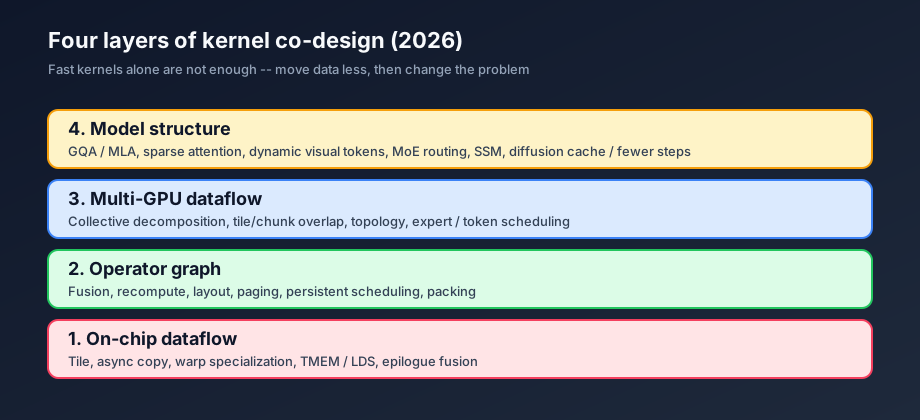
In 2026, foundation-model kernel work is four-layer co-design:
- On-chip dataflow — tiles, async copy, warp specialization, TMEM/LDS, epilogues;
- Operator graph — fusion, recompute, layout, paging, persistent scheduling;
- Multi-GPU dataflow — collective decomposition, tile overlap, topology, expert/token scheduling;
- The model itself — GQA/MLA, sparse attention, dynamic visual tokens, MoE routing, SSM, diffusion cache / fewer steps.
The strongest recipes usually move two or three layers at once:
- MLA + paged/quantized KV + split-KV decode kernel
- Dropless MoE + grouped GEMM + DeepEP + tile-level overlap
- Dynamic resolution + multimodal packing + varlen FlashAttention
- DiT + FP8 fused GEMM/attention + temporal cache + patch parallel
- Parallel decoder block + TP/SP chunk overlap + fused branch output/collective
- MoE Parallel Folding + GroupedGEMM + Flex dispatcher + shared-expert/A2A overlap
So the right question is not “which kernel is fastest?” It is: under real shapes, real topologies, and real precision constraints, which model expression and data layout make critical bytes cross HBM/network as rarely as possible — and keep the remaining compute saturating the machine?